
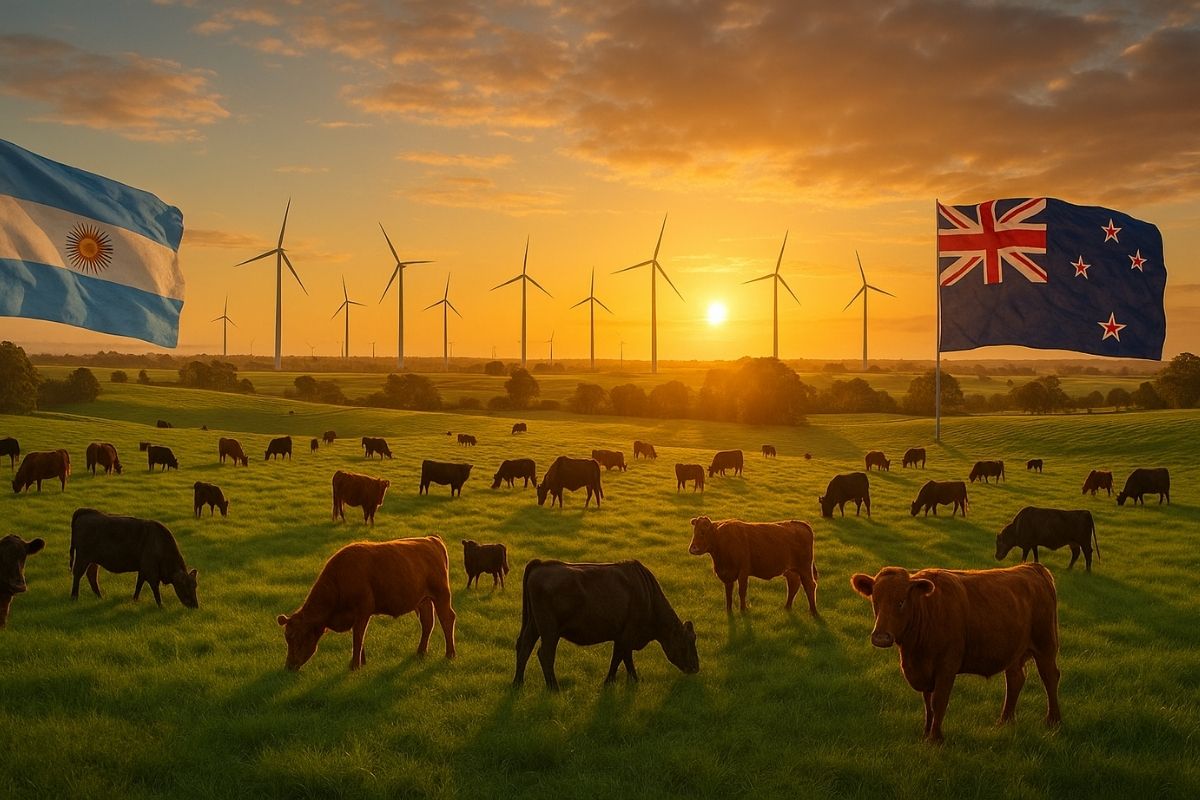
When nature saves us: How two countries prove that radical reforms can heal the planet
Esteemed readers, while in Germany every gram of CO₂ is being debated and we’re being told that we are to blame for climate change, revolutionary transformations are taking place in other parts of the world that show us a completely different truth. Two countries have proven: Real change doesn’t come from sacrifice and bad conscience, but from courageous action and intelligent systems that work with nature instead of against it.
Argentina has achieved a spectacular economic turnaround in less than two years that leaves even experienced economists speechless. New Zealand already demonstrated in the 1980s how the complete abolition of subsidies can lead to unimaginable success. These two success stories reveal an important truth for all of us: Nature is the best CO₂ absorber in the world – we just have to help it, and this is best achieved through intelligent agriculture that turns meat-eaters into world savers.
Today I show you why these two countries are models for a new way of doing business, how extensive livestock farming becomes a climate savior, and why the positive Earthprint determines the future of our planet. Because one thing is clear: There is no technical solution that can bind CO₂ and save the environment as quickly and efficiently as nature itself – but we have to help it.
Argentina’s resurrection: From bankruptcy to economic miracle in 18 months
To understand what incredible transformation has taken place in Argentina, we must first consider the catastrophic starting situation that brought the country to the edge of the abyss. When Javier Milei assumed the presidency in December 2023, he inherited from the previous Peronist government a country that was literally facing total economic collapse.

The legacy of mismanagement: When a country collapses
Hyperinflation had reached 211 percent in 2023, the highest value worldwide – this means concretely that prices had more than tripled within a single year. To put this in perspective: What cost one euro today cost only about 30 cents a year ago. This inflation was so extreme that monthly rates sometimes climbed over 25 percent – meaning every month all products became a quarter more expensive. For normal families this meant that their income was practically losing value daily.
The country was on the brink of another state bankruptcy, which would have been the ninth in Argentine history. The state budget showed massive deficits that were systematically financed by printing money – a vicious circle that further fueled inflation. 45 percent of the population – almost every second Argentine – lived in poverty, many of them in extreme poverty without adequate nutrition or medical care.
Foreign exchange reserves, meaning the foreign currencies that a country needs for international trade and imports, were nearly exhausted. Without these reserves, Argentina could no longer import important goods and threatened to be disconnected from the world economy. International investors had completely lost confidence in Argentina and were massively withdrawing their money, further aggravating the crisis. This combination of hyperinflation, impending state bankruptcy, mass poverty, and loss of confidence would normally have meant the definitive end of an economy.
The “chainsaw policy”: When courage meets desperation
What Javier Milei then did was so radical and uncompromising that even experienced economists and politicians worldwide were left speechless. He implemented unprecedented harsh austerity policies that became known as “chainsaw policy” – an image that perfectly illustrates how uncompromisingly and quickly he dismantled inefficient state structures, without regard for political sensibilities or interest groups.
Public spending was cut by a real 30 percent – a completely unprecedented austerity course in the history of modern democracies. To illustrate this: If the state previously spent 100 billion, it now spent only 70 billion. This reduction didn’t occur over years, but within a few months, giving the entire reform program its extraordinary impact.
About 50,000 state employees were dismissed, which corresponded to about one-seventh of the entire public service. These weren’t arbitrary dismissals, but the systematic dismantling of bloated administrative structures that caused more costs than benefits. Numerous ministries were dissolved or merged, which not only saved personnel costs but also increased the efficiency of government work.
Subsidies for energy, transport, and other areas were completely eliminated. These subsidies had led over years to energy and transport being artificially cheap, leading to waste and ruining state finances. Social programs were drastically cut and state construction projects were stopped, with Milei arguing that a bankrupt state could help no one and first had to be rehabilitated before social policy would be possible again.
Over 200 regulatory ordinances were abolished to free the economy from bureaucratic shackles. This deregulation aimed to give companies the opportunity again to work productively without having to fight through a labyrinth of regulations.
Additionally, the peso was massively devalued by 54 percent – this meant that the Argentine currency lost overnight less than half of its previous value. This devaluation was painful but necessary to end the artificial overvaluation of the currency and restore the competitiveness of the Argentine economy.
The government also ended the decades-long practice of financing budget deficits by printing money – a practice that had significantly contributed to hyperinflation. Instead, strict budget discipline was introduced that stated that only what is also collected can be spent.

Spectacular results: When economic theory meets reality
The results of Milei’s radical reforms not only exceeded all expectations but also refuted critics who had predicted social catastrophe and economic collapse. Instead, Argentina experienced one of the fastest economic recoveries in modern history.
The monthly inflation rate plummeted from over 25 percent to only 1.6 percent in June 2025 – a decline of over 90 percent that puzzled even experienced economists. The annual inflation rate fell dramatically from 211 percent to about 39 to 40 percent. To understand this: While prices previously doubled within a few months, they now only rose in a normal, controllable framework that allowed families and businesses to plan and economize again.
After a brief but intense recession in 2024 with a decline of 1.8 percent – which was inevitable to dismantle the bloated, unproductive structures – Argentina now experiences impressive economic growth. The International Monetary Fund forecasts growth of 5.5 to 5.7 percent for 2025 – the second-highest growth worldwide after India. For 2026, another 4.5 to 4.8 percent is expected. This means that the Argentine economy, after the brief but necessary shock, now grows faster than almost all other countries in the world.
For the first time in 14 to 16 years, Argentina records a budget surplus of 1.8 percent of gross domestic product – a historic success for a country with chronic deficits. This surplus means not only that the state can pay its bills, but also that it has room again for investments in infrastructure and education without incurring new debt.
The renowned rating agency Moody’s upgraded Argentina’s creditworthiness, meaning that international investors have confidence in the country again. The International Monetary Fund was impressed by the development and highlighted Argentina as an example of successful structural reforms. International investors returned en masse, and a tax amnesty program led to about 19 billion dollars – money that Argentines had stored abroad – flowing back into Argentine banks.
Particularly remarkable is the development of poverty, which is often cited as an argument against austerity measures: Although poverty initially rose to 53 percent – which was due to the short-term hardships of adjustment – it has meanwhile fallen to 31 percent, significantly below the value at Milei’s inauguration. This lifted several million Argentines out of poverty, a success that shows that short-term hardships can lead to long-term prosperity and that a functioning state ultimately does more for the poor than a bankrupt state with many social programs.
New Zealand’s pioneering spirit: The historical model for courageous reforms
Argentina’s spectacular success doesn’t stand in isolation but finds its historical model in New Zealand’s revolutionary agricultural reforms of the 1980s – one of the most successful and radical examples of the complete abolition of subsidies in a developed economy. This story is particularly fascinating because it shows that radical reforms can lead to extraordinary successes not only in acute crisis times but also in the long term over decades.
When the state was bankrupt: New Zealand’s critical hour
New Zealand found itself in the early 1980s in a similarly precarious situation as Argentina before Milei, even though the crisis was less spectacular but no less dangerous. The country faced state bankruptcy and had developed over decades an extremely subsidized agriculture that had become completely disconnected from world market reality and economically senseless.
Up to 40 percent of agricultural income came from state subsidies – this means concretely that almost half of what New Zealand farmers earned wasn’t generated through the sale of their products to actual customers, but was financed by taxpayer money. These subsidies had led farmers to no longer pay attention to what the market really wanted or what was economically sensible to produce.
Almost 30 different subsidy and export support programs existed in parallel – a bureaucratic maze of meat premiums, wool subsidies, fertilizer subsidies, transport allowances, credit facilities, and dozens of other programs that no one understood anymore and that hindered each other. Farmers spent more time filling out applications and applying for subsidies than caring for their animals and fields.
Overproduction had become so extreme that the system took on completely absurd and uneconomical features: Six million surplus lambs had to be kept on cargo ships off the coast because despite all subsidies, there were no buyers for them. The ships became floating stables, which was not only expensive but also torture for the animals.
2 million hectares of marginal land were only profitable through subsidies – land that due to its composition, location, or quality should never have been used agriculturally and was completely uneconomical without state support. This artificial cultivation led to environmental damage and tied up resources that could have been used more sensibly elsewhere.
In 1983, 6,000 tons of surplus sheep meat had to be processed into fertilizer because nobody wanted to buy it, even though it had been produced with tax money. At the same time, people in other parts of the world were starving while subsidized meat was being destroyed in New Zealand.
This situation illustrates the fundamental problem of state subsidies in agriculture: They distort market signals so strongly that completely uneconomical activities are promoted, while simultaneously resources are wasted, the environment is damaged, and state finances are ruined. Farmers become dependent on political decisions instead of their customers’ needs, and the entire system becomes inefficient and detached from reality.

The great liberation blow: Why everything changed overnight
In 1984, the newly elected Labour government under Prime Minister David Lange and Finance Minister Roger Douglas implemented an unprecedented reform course known as “Rogernomics”. What then happened was unique in its radicality and speed in the history of developed countries: In a coordinated night-and-fog action, all agricultural subsidies were completely and immediately abolished.
This decision wasn’t spontaneous but was based on the recognition that gradual reforms wouldn’t have worked. Too strong were the interests of the beneficiaries of the old system – farmers’ associations, subsidy administrators, political interest groups, and companies that lived off the subsidy system. Any announcement of gradual reforms would have led to massive lobbying actions, protests, and political interventions that would have watered down or completely prevented the reforms.
All price supports for sheep meat, beef, wool, and dairy products were immediately ended. This meant that farmers from one day to the next only received what customers were willing to pay, no longer what politicians considered appropriate. Subsidies for fertilizers, irrigation, transport, and land development disappeared without replacement. Tax breaks and free state services for farmers were eliminated. Subsidized loans and other financial aids were abolished.
This radical abolition of all subsidies overnight was unique among developed countries and went far beyond what had ever been attempted in other states. Even market-oriented countries like the USA or Germany still have extensive agricultural subsidies today, but New Zealand dared the complete exit.
The government justified this radical step with several arguments: First, the state was bankrupt and simply couldn’t afford the subsidies anymore. Second, the subsidies had become counterproductive and led to waste instead of prosperity. Third, only through a complete fresh start could it be prevented that individual interest groups cherry-picked or fought for exceptions.
Forty years later: Why New Zealand is leading today
The results of New Zealand’s radical reforms after four decades are so extraordinary that they not only refute all catastrophic predictions of the time but reverse them. Critics had predicted that New Zealand agriculture would collapse, hundreds of thousands of farmers would be driven to ruin, and the country would lose its position as an agricultural nation. The opposite happened.
The New Zealand meat industry developed from the most inefficient to the second most efficient in the world – a success that would never have been possible without the artificial crutches of subsidies. Today the agricultural sector is not only larger than in times of strong state support but has simultaneously become more efficient, innovative, sustainable, and internationally competitive.
Agriculture became more profitable, efficient, and innovative in every respect. Farmers suddenly had to focus on what customers really wanted instead of what subsidies were available. This led to a revolution in product quality, efficiency, and customer orientation. Despite completely eliminated subsidies, farmers today earn significantly more than in times of state support because they work more productively and achieve better prices for higher quality products.
Contrary to all gloomy predictions, only about 800 of 80,000 operations went out of business – barely one percent. These few operations were those that weren’t really economical even with subsidies and were only kept artificially alive. The overwhelming majority of operations not only survived but prospered. Employment in the agricultural sector even increased because more efficient, profitable operations employed more people than the previously artificially maintained uneconomical structures.
New Zealand farmers developed impressive innovation and new business models. They specialized in high-value segments like kiwi fruit, organic products, and premium meat and developed additional income sources like eco-tourism, direct marketing, and specialized services. This diversification was only possible because they were no longer dependent on subsidies and received real market signals that showed them what customers really wanted.
The environmental impacts of the reforms were also consistently positive, although environmental protection wasn’t the primary goal. Fertilizer consumption fell by 50 percent because farmers suddenly had to calculate economically and only fertilized as much as was economically sensible. Marginal land was taken out of unproductive use and returned to nature, leading to ecosystem regeneration. Reforestation increased by 50 percent because uneconomically grazed land was reforested and farmers found a profitable alternative in timber plantations.
Today New Zealand is among all OECD countries the one with the lowest agricultural subsidies and is considered internationally as a model case for successful market-based agriculture. The country exports 85 to 90 percent of its agricultural products – a sign that the products are internationally competitive – and has maintained and even expanded its position as one of the world’s largest and most efficient agricultural producers, although – or precisely because – the state has completely withdrawn from support.
The OECD attributes New Zealand’s success to several critical factors that are also instructive for other countries: the existence of a real fiscal crisis that justified cuts and overcame political resistance; the systematic involvement of affected interest groups in the reform process to create understanding; transparent and binding timetables for reforms that created planning security; the credible conviction of all actors that there would be no return to the old policy; and accompanying temporary social assistance during the most difficult transition period.
The uncomfortable truth about climate guilt: Who is really responsible
While media, politics, and activists daily tell us that every individual is responsible for climate change and that only through personal sacrifice can the climate be saved, the cold facts show a completely different, much more complex picture. This insight is crucial to understanding why the successes of Argentina and New Zealand are so important and what they mean for real, effective climate protection that goes beyond symbolic gestures.

State corporations as climate killers: The numbers speak a clear language
The reality of global CO₂ emissions is sobering and exposes the hypocrisy of the individual sacrifice debate brutally: State enterprises were responsible for 52 percent of global CO₂ emissions in 2023, while the five largest private companies together caused only 4.9 percent. These numbers show with alarming clarity: The biggest climate sinners are not private individuals who drive cars, fly, or eat meat, but state monopolies and state-affiliated companies.
These state-affiliated corporations often operate without real market competition, have no incentives for efficiency, and can pass their costs – including environmental costs – on to the general public. They are subject neither to pressure from competitors nor from shareholders who could demand efficiency and sustainability. Instead, they follow political goals and bureaucratic structures that are often inefficient, wasteful, and environmentally harmful.
Individual measures certainly have their significance and every individual should take responsibility – that’s beyond question. But they are practically severely limited and their effect is completely overestimated when at the same time the real major emitters get away scot-free and are even promoted. The obsessive focus on individual sacrifice systematically distracts from the real, structural problems and prevents effective solutions that could really achieve something.
Industrial livestock farming: The problem lies in the system, not in the meat
Industrial mass livestock farming is indeed a massive environmental problem – but here lies the fundamental thinking error of the entire debate: The problem is not the meat itself or people’s meat consumption, but exclusively the way animals are kept, fed, and processed in this perverse system.
Mass livestock farming causes massive environmental pollution through concentrated manure and wastewater that contaminate waters and soils. It leads to soil erosion through overgrazing and incorrect management methods as well as species extinction through the destruction of natural habitats for monocultures for animal feed production. It contributes up to 20 percent to global greenhouse gases, mainly through the inefficient production of animal feed and the unnatural concentration of animals in the smallest space.
But – and this is the decisive point – that’s a problem of the industrial mass livestock farming system, not a problem of meat or meat consumption itself. Extensive, species-appropriate pasture farming works completely differently and can even contribute massively to climate protection, promote biodiversity, and regenerate ecosystems, as we will see in detail below.
The call for meat abstinence is therefore not only counterproductive but directly harmful because it distracts from the real solution – the conversion to extensive, sustainable pasture farming – and instead fuels a sham debate about individual sacrifice.
Extensive livestock farming: How cows become climate heroes
The revolutionary insight that comes both from New Zealand’s long-term success and from the most modern findings of agricultural science and ecology reads: Properly used extensive livestock farming is one of the most effective natural CO₂ stores in the world and can simultaneously produce high-quality food. This insight turns the entire climate debate upside down and shows why intelligent meat-eaters can actually save the world – if they eat the right meat from the right systems.
Humus building: The underestimated and most powerful climate saver
The scientific facts about carbon storage in soils are clear and dramatic: Humus-rich meadows can store up to 180 tons of CO₂ per hectare – that’s more than twice as much as conventional arable soils with an average of only 95 tons. Under well-managed permanent grassland, an average of 181 tons of carbon per hectare are bound, while optimally managed drained peat soils can store even 507 tons.
These numbers illustrate the enormous, largely unused potential of grassland as CO₂ storage. For comparison: An average car emits about 2.3 tons of CO₂ per year. A single hectare of well-managed grassland can therefore compensate for the emissions of over 80 cars – and that year after year, decade after decade.
Extensive grazing increases humus content dramatically and sustainably, through several natural mechanisms that reinforce each other. The controlled movements of grazing animals naturally loosen the soil, promote aeration, and favor important microorganisms that are essential for humus formation. The hooves of the animals press plant seeds into the soil and create small depressions that collect rainwater and promote the growth of new plants.
The natural dung of the animals organically fertilizes the soil and promotes both plant growth and the activity of soil organisms. Unlike artificial fertilizer, organic animal manure is broken down slowly and continuously, leading to a sustainable nutrient cycle. The loose soil structure resulting from extensive grazing in combination with intensive rooting through diverse grasses and herbs enables better water penetration and prevents erosion.

The rewilding concept: Back to natural, regenerative systems
Modern rewilding concepts show the concrete path to a climate-friendly but simultaneously productive and economic future of agriculture. Rewilding doesn’t mean that humans completely withdraw from nature and let everything run wild, but that they learn to work intelligently with natural systems instead of fighting against them.
Through the systematic conversion of industrial mass livestock farming to extensive, healthy, and species-appropriate pasture farming, natural CO₂ stores of enormous capacity are created. At the same time, high-quality, healthy meat is produced, jobs are created in rural regions, and natural ecosystems are regenerated.
Holistic Management according to Allan Savory has proven in practical trials that large cattle herds in compact formation can mimic natural wild animal herds like buffalo or antelopes and thereby systematically regenerate degraded landscapes. The crucial insight: Grazing animals don’t move uniformly and continuously over large areas in nature – that leads to overgrazing and degradation. Instead, they move in dense herds that graze briefly and intensively and then move on for longer periods so that vegetation can recover.
This natural grazing pattern stimulates plant growth through the so-called “Grazing Effect” – moderate grazing stimulates grasses to grow more vigorously. It increases biodiversity because different plant species react differently to grazing, creating a mosaic of different habitats. It systematically builds soil carbon because grass roots grow more vigorously after each grazing cycle and thereby store carbon in the soil.
Regenerative agriculture relies exactly on these proven natural principles: soil health as the foundation of all productivity, biological diversity as a stability factor, and the intelligent integration of animals into agricultural systems. Extensive grazing on large, contiguous areas can harbor 200 and more different plant species – from grasses to herbs to shrubs and trees. In contrast, modern seeded grassland often shows only ten or fewer different species.
This extraordinary biodiversity is not only ecologically valuable and beautiful to see but also makes the entire system much more resistant to climate extremes like droughts, floods, or temperature fluctuations. Different plant species react differently to environmental conditions, so that in all weather conditions some species always grow well and stabilize the system.
Carbon farming: When farmers become CO₂ collectors and climate protectors
Carbon farming, i.e., the targeted carbon storage in agricultural soils as a conscious climate protection measure, is already being developed and promoted in the European Union as an additional income source for farmers. The basic idea is simple and ingenious: Farmers can not only produce food but simultaneously bind CO₂ from the atmosphere in the soil and be additionally compensated for it.
This dual use – food production plus CO₂ storage – makes extensive livestock farming economically much more attractive and creates strong financial incentives for climate-friendly management. Farmers can thereby increase their income while practicing active climate protection. That’s a real win-win situation that benefits all parties involved.
The EU Commission is working on certification systems that will enable farmers to sell demonstrably stored carbon. Companies that want or must compensate for their CO₂ emissions could then buy carbon certificates directly from farmers, promoting decentralized, regional climate protection projects and simultaneously strengthening rural development.
The rewilding cooperative concept: The practical implementation of the future vision
To implement the theoretical insights about extensive livestock farming in practice, we Earth Guardians have developed a concrete concept: the rewilding cooperative model for the immediate and complete conversion of industrial mass livestock farming to extensive, healthy, animal and species-appropriate pasture farming.
The cooperative idea: Collectively to success
The cooperative model solves one of the main problems in the transition from industrial to extensive agriculture: the high capital requirement for large areas and the long conversion time during which farmers must accept income losses. Through cooperative association, even smaller farmers can afford the transition and together create large, contiguous grazing areas that are required for Holistic Management.
The cooperative members – who can be farmers, environmentalists, conscious consumers, or investors – jointly finance the purchase or long-term lease of areas that are then managed according to rewilding principles. The revenues from meat sales, carbon credits, and other income sources are fairly distributed among the members.
Immediate conversion instead of lengthy transitions
In contrast to conventional conversion programs that take years and carry high loss risks, the cooperative model enables immediate and complete conversion. Existing fattening operations can sell or lease their animals directly to the cooperative, which then immediately converts them to extensive pasture farming.
The industrial stable facilities are no longer needed and can be used for other purposes or dismantled. The freed areas are immediately converted into grazing areas. The animals experience an immediate gain in quality of life, and CO₂ binding begins immediately.

Species-appropriate keeping as a basic principle
All animals in rewilding cooperatives live exclusively on pasture, in natural herd associations and with natural behaviors. No animal spends its time in stables or confined conditions. Feeding is done exclusively through pasture grass and natural vegetation, without concentrated feed, antibiotics, or growth promoters.
The herds are managed according to Holistic Management principles: short, intensive grazing followed by long rest periods for vegetation. The animals have constant access to fresh water, shade places, and various plant species they can eat according to need.
This species-appropriate keeping leads not only to healthier, happier animals but also to higher quality meat with better nutritional values, omega-3 fatty acids, and other health-promoting substances.
The positive Earthprint: Giving more than taking
While everywhere there’s talk of CO₂ footprints, climate guilt, and reduction targets, we Earth Guardians are developing a completely different, much more positive and constructive concept: the positive Earthprint. This revolutionary approach goes far beyond damage limitation, neutrality, or compensation and actively strives for people and companies to contribute more to the environment and world prosperity than they consume or damage.
What does positive Earthprint mean concretely?
The term “Earthprint” (German: Erdabdruck) describes the positive, regenerative influence of a person, organization, or community on the entire Earth system – i.e., on climate, soils, waters, air, biodiversity, and human communities. In contrast to established concepts like the “ecological footprint,” “handprint,” or “climate positive,” the Earthprint goes radically beyond damage limitation and CO₂ compensation.
The Earthprint encompasses all activities that actively contribute to the healing, restoration, regeneration, and transformation of ecosystems, climate, biodiversity, water and soil quality, as well as social communities. It’s not about causing less damage but about actively creating benefit and leaving the world better than one found it.
As Francesco del Orbe, I don’t just neutralize everything I use from nature and possibly damage, but I actively ensure that my actions have a positive net effect on the planet. I expect the same from every company I work with. I no longer want anything to do with companies that don’t handle this the same way and don’t recognize the enormous opportunities and infinite profit from converting to positive Earthprint.

The personal Earthprint strategy
I no longer have a CO₂ footprint – I also no longer have a CO₂ handprint. I have a positive Earthprint and consciously and systematically take ecological responsibility for everything I do, because obviously nobody else does it. This means concretely: For every resource I consume, I ensure that at least the same amount is regenerated. For every emission created by my life, I ensure the binding of at least the same amount of CO₂. For every habitat affected by my activities, I ensure that at least the same area is renaturalized or protected.
But that’s just the beginning: Beyond that, I actively engage in rewilding projects, extensive livestock farming, reforestation, and other regenerative activities that benefit the environment more than my entire life costs. This makes my earth footprint positive – I give more back to the planet than I take.
The economic opportunities of the Earthprint concept
Companies that understand and consistently implement the Earthprint concept don’t just gain a competitive advantage but tap into completely new markets and profit sources. When every person and every company takes responsibility for their own actions and consumption and additionally actively contributes to improving the environment, then our environmental problems not only dissolve very quickly but enormous economic opportunities also arise.
This eco-positive attitude means that more environmental resources are created directly or indirectly than are consumed. Companies that achieve this become sought-after partners for environmentally conscious customers, investors, and other companies. They can offer their products and services not just climate-neutral but climate-positive. They create real added value instead of just less damage.
The market for regenerative, climate-positive products and services is growing exponentially, and companies with positive Earthprint will be the big winners of this change. They combine ecological responsibility with economic success and prove that environmental protection doesn’t mean sacrifice but innovation, growth, and profit.
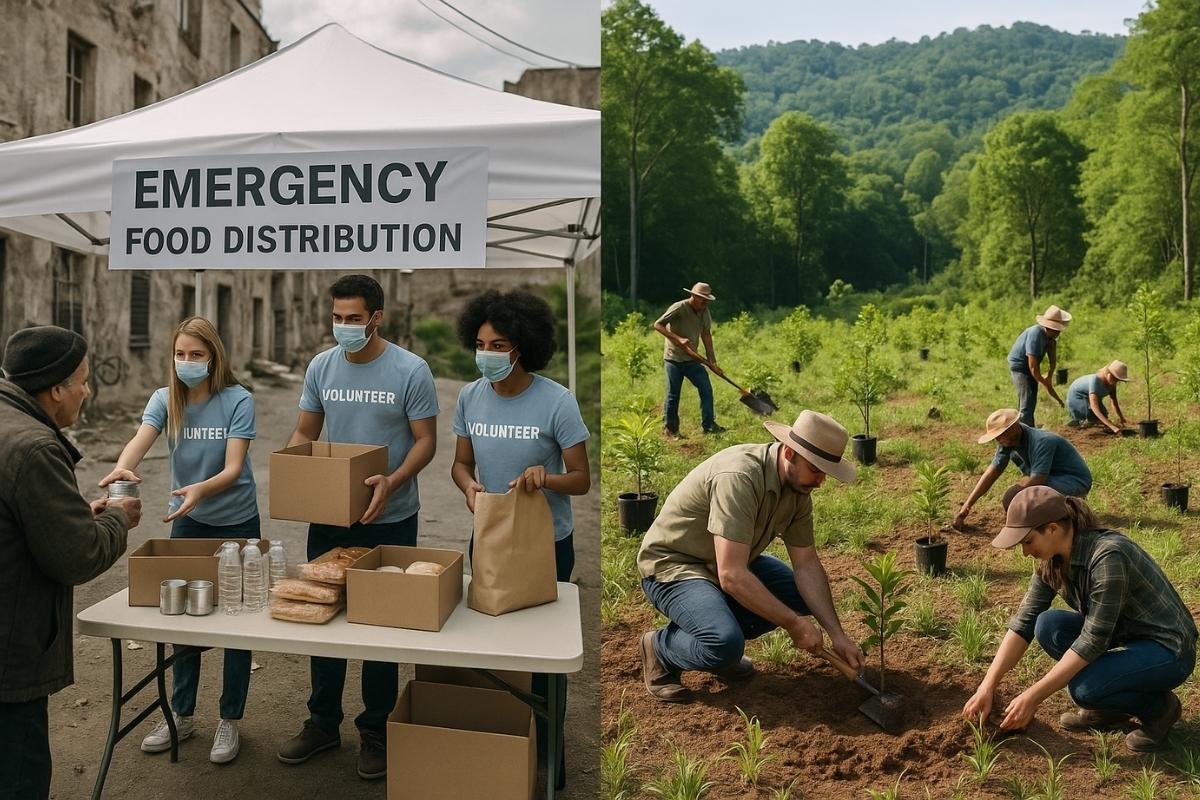
Climate donations instead of social donations: The underestimated and underfunded solution
Another crucial aspect that completely disappears from public debate and massively hinders the solution of our environmental problems is the dramatic underfunding of climate protection measures compared to conventional social projects. This fatal imbalance in donation distribution prevents effective solutions and perpetuates exactly the problems it’s supposed to solve.
The fatal and irrational distribution of global donation money
The numbers are shocking: Worldwide, infinite amounts of money are spent on traditional social donations – for disaster relief, development aid, poverty reduction, medical aid, and similar projects. But for climate donations – which simultaneously and often much more effectively protect and create new living spaces for people, create sustainable livelihoods for entire families and communities, bring rain back to arid areas, get children into school through improved living conditions, and ultimately can prevent climate migration of billions of people – less than 1 percent of all donation money is used worldwide.
This distribution is not only illogical and inefficient but also deeply counterproductive and short-sighted. It treats the symptoms of problems instead of addressing their causes. It helps people short-term but often creates dependencies and doesn’t solve the fundamental problems that lead to poverty, hunger, migration, and social problems.
Climate protection as comprehensive social aid
Intelligent, well-planned climate protection projects often have direct, measurable, and sustainable social benefits that go far beyond pure environmental effects. They create permanent jobs in rural areas where often the greatest poverty exists. They improve the long-term livelihoods of families through regenerated soils, clean water, and stable harvests. They stabilize local ecosystems and make communities more resistant to climate extremes. They prevent environmental migration by giving people a future in their homeland.
A well-designed rewilding project in Africa can, for example, simultaneously bind large amounts of CO₂, create jobs for hundreds of families, improve food security of entire regions, stabilize water supply, stop soil erosion, promote biodiversity, and give families a long-term, sustainable future. Despite this, most donation money still flows into symptomatic, short-term aid measures instead of such causal, sustainable solutions.
The incredible power of coordinated small contributions
The mathematical reality is astounding: Every Earth Guardian can create new worlds and cause massive positive changes starting from just 0.09 cents per day – that’s about 33 euros per year – if we take the global gross domestic product as a basis and act intelligently and coordinatedly. This calculation makes clear that effective climate protection isn’t about major individual sacrifices or giving up quality of life, but about intelligent coordination, collective action, and the right distribution of resources.
When millions of people make small but regular contributions and use them targeted, intelligently, and coordinatedly for climate protection projects that simultaneously have massive social benefits, we can achieve enormous, measurable, and permanent changes in just a few years. The power of collective action is systematically underestimated because each individual feels powerless – but together we are incredibly strong.
Why climate donations are underfunded: The psychological and systemic causes
There are several reasons for the dramatic underfunding of climate protection projects. First, social problems are more visible and emotionally tangible than climate problems – a hungry child is immediately understandable, while climate change acts abstractly and long-term. Second, social projects often have faster, visible successes, while climate projects take longer for their effect to become visible. Third, climate financing is more complex and technical, which deters many donors.
But above all, there’s a lack of understanding that climate protection is the best, most sustainable, and most effective form of social aid. Instead of repeatedly helping people out of poverty, climate projects prevent them from falling into poverty in the first place. Instead of caring for refugees, they prevent people from having to flee at all. Instead of fighting famines, they create stable food bases. That’s real, sustainable help instead of symptomatic treatment.
The Earth Guardian movement: Rights for our threatened planet
The impressive examples of Argentina and New Zealand show unmistakably that radical, courageous reforms are not only possible but also extraordinarily successful when the political will, courage for change, and willingness for short-term hardships for long-term improvements are present. But they also show something else equally important: We don’t have to wait passively for governments, politicians, or international agreements. Every individual can become an Earth Guardian today, immediately, and actively contribute to solving the great challenges through intelligent, thoughtful decisions.
Why the Earth urgently needs rights: The children’s room argument
We Earth Guardians are proud members of the Global Alliance for the Rights of Nature (GARN), a worldwide movement that fights for nature – our all life foundation – to finally get the rights it deserves and that are essential for our survival. The idea of giving nature its own, enforceable rights may initially seem unusual or even esoteric, but upon closer examination it’s not only logical and necessary but actually long overdue.
If corporations as legal persons have comprehensive rights – property rights, litigation rights, even certain human rights – why not also nature, on which our all life, health, and prosperity completely depends? If a corporation can go to court to defend its interests, why can’t a forest, river, or ecosystem do the same?
Our argument is simple and compelling: If we were really adults, we would never deal with our home so irresponsibly and destructively as we currently do. At least I don’t know any reasonable adults who would drive a bulldozer through their living or bedroom, burn their furniture, poison their water pipes, or saturate the floor of their house with toxic chemicals. But that’s exactly what we do daily with our shared children’s room Earth.
The Earth Guardian call: Act yourself instead of waiting endlessly
Now is our time as Earth Guardians. Let us finally grow up and protect the Earth, give it the rights it needs – let us enjoy with responsibility and consciously and actively preserve our shared “children’s room Earth.” The corresponding petition that you should all sign can be found at https://www.rightsofmotherearth.com/what-we-do.
Our main slogan perfectly captures the necessary attitude: “If you really want to be sure that something gets done, then just do it yourself!” This statement is not just a slogan but a call to action and a practical life philosophy. Governments act too slowly, too half-heartedly, and too interest-driven. Corporations only act when it’s profitable. International organizations are often paralyzed by bureaucracy and contradictory interests.
But every individual can become an Earth Guardian today and contribute to healing the planet instead of just damaging it less through intelligent agriculture, conscious consumption, and active support of regenerative projects. There is no technical solution that can bind CO₂ and regenerate the environment as quickly, cost-effectively, and efficiently as nature itself – we just have to help it.
The rewilding cooperative concept as a practical path
A concrete, practical path to this is our self-developed rewilding cooperative concept for the immediate and complete conversion of environmentally harmful industrial mass livestock farming to extensive, healthy, animal and species-appropriate pasture farming. This concept shows how we can implement the theoretical insights about climate protection, animal welfare, and sustainable agriculture into practical, profitable, and scalable solutions.
Instead of endlessly discussing problems, we create solutions. Instead of waiting for political decisions, we act ourselves. Instead of preaching sacrifice, we show how intelligent consumption and production can lead to more quality of life for all – humans, animals, and the entire planet.
The way forward: Why intelligent meat-eaters save the world
The fascinating stories of Argentina’s spectacular economic transformation and New Zealand’s long-term agricultural success, combined with scientifically based insights about extensive livestock farming, humus building, and natural CO₂ storage, lead to a revolutionary but logical conclusion: Intelligent, conscious meat-eaters can actually save the world – but only if they eat the right meat from regenerative rewilding programs and extensive pasture farming instead of cheap meat from industrial mass livestock farming.
End of sacrifice romanticism: Intelligent solutions instead of bad conscience
Don’t let them tell you the complete nonsense anymore that you are alone or mainly responsible for the climate catastrophe and could save the world with individual meat abstinence, bicycle riding, and shower shortening. That’s not only factually wrong, as we’ve seen, but also psychologically harmful and strategically counterproductive. The opposite is true: Extensive livestock farming that produces high-quality, healthy meat while simultaneously binding large amounts of CO₂, massively promoting biodiversity, and systematically regenerating degraded landscapes is one of the most effective and fastest climate protection measures in the world.
Instead of unrealistic, pleasure-hostile, and ultimately ineffective sacrifice romanticism that only creates bad conscience but solves no problems, we Earth Guardians promote the pragmatic, positive, and successful approach: Be yourself the change you wish for this world, as Mahatma Gandhi so aptly said. This change doesn’t mean sacrifice, asceticism, or falling back into pre-industrial conditions, but intelligent, thoughtful decisions for products, systems, and ways of life that harmonize with nature instead of fighting against it.
The vision of a regenerative, abundant future
Our vision as Earth Guardians reads: “Help us create a livable planet for a happy and healthy life and coexistence.” This vision is not utopian, dreamy, or unrealistic, but practically implementable and economically profitable, as the impressive successes of Argentina and New Zealand unmistakably demonstrate. When we establish the right systems, understand and intelligently apply natural principles, we can simultaneously be economically successful, live well and healthily, and systematically heal the planet instead of just damaging it less.
The future doesn’t lie in sacrifice but in abundance – but an intelligent, sustainable abundance based on regenerative principles. We can eat, live, and enjoy more and better when we change the systems that produce our food. Meat from extensive pasture farming is not only climate-friendly but also healthier, tastier, and ethically unobjectionable. Regenerative agriculture can produce more food on less land while simultaneously improving the environment.
The Earth Guardian lifestyle: Practical and inspiring
As Francesco del Orbe, the Earth Guardian, I explain to you: “The world would be many times better if we listened more to our common sense, took time for each other, and treated everything with respect – nature, animals, and ourselves.” This respect doesn’t mean distance or sacrifice but intelligent, responsible interaction.
Respect for nature means understanding and using its cycles, principles, and potentials instead of fighting against them. Respect for animals means enabling them to have a species-appropriate, natural life instead of torturing them in factories. Respect for ourselves means eating healthy, nutritious food and supporting systems that benefit everyone.
Conclusion: The time of the Earth Guardians has begun
The time of useless sacrifice romanticism, bad conscience, and helplessness is definitively over. The time of the Earth Guardians has begun, and with it a new era of intelligent, regenerative, and successful interaction with our planet. The examples of Argentina and New Zealand have unmistakably shown: When something important needs to be done and you really want to be sure it’s done right and successfully – just do it yourself!
Become an Earth Guardian too and help us systematically cool down the planet by developing your positive Earthprint and living eco-positively – i.e., creating or protecting more environmental resources than you consume. Support extensive livestock farming through conscious meat consumption. Invest in rewilding projects. Donate for climate protection instead of just symptom treatment.
Let us now save our shared home – our Mother Earth – because we all are the world! The tools are available, the solutions are known, the successes are proven. Now it’s up to us to apply them. Because as I always say: “Act yourself. Transform together.”
The future doesn’t belong to those who complain and sacrifice, but to those who act and shape. The future belongs to the Earth Guardians. Become one of us!


