
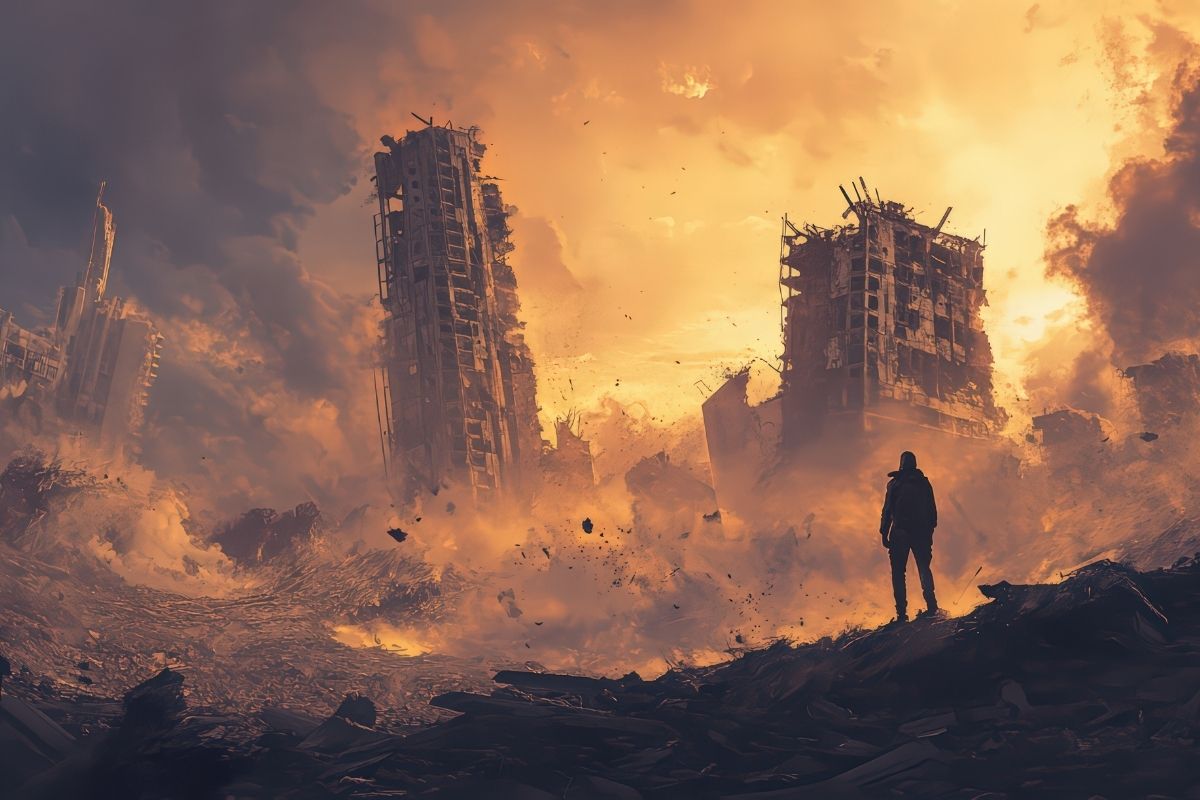
When Ancient Prophecies Become Disturbing Reality: Are We Really Living in the End Times?
Dear readership, let us take a look today at a topic that concerns millions of people worldwide and has acquired completely new urgency in our time.
While the news daily reports on climate catastrophes, geopolitical tensions, and social upheavals, people of all faiths are asking themselves a fundamental question: Are the millennia-old prophecies about the end of time being fulfilled before our eyes?
This question is by no means relevant only for religious people. Because regardless of personal beliefs, the holy scriptures of world religions have dealt for millennia with crises that are strikingly similar to our current situation. Whether one is Christian, Muslim, Hindu, Buddhist, or a follower of another faith – or even not religious at all – the parallels between ancient predictions and current world events are so remarkable that they deserve closer examination.
In this article, we will systematically examine what the various religions teach about the end times, what specific signs they prophesy, and how these might be connected to current developments. We will consider both religious interpretations and scientific facts, and ultimately explore the question of whether these developments are inevitable or whether we still have the possibility of bringing about a positive change.

The Greek Word That Moves the World: What “Apocalypse” Really Means
When we speak of the biblical end times, we first encounter a term that is often misunderstood: the apocalypse. The Greek word “apokalypsis” literally means “revelation” or “uncovering” – so it does not primarily describe destruction, but the revelation of hidden truths about the future of the world.
The Revelation of John, the last book of the Bible, was probably written around 95 AD on the Greek island of Patmos. John, one of the twelve apostles of Jesus, describes visions of the end of time and the second coming of Christ. These visions are full of symbolic images: seals being opened, trumpets being blown, and bowls of wrath being poured out over the earth.
For Christians, Revelation is more than a prophetic book – it is a message of hope amid persecution and suffering. The early Christians, who suffered under the rule of the Roman Empire, found comfort in these visions and the certainty that God would ultimately defeat evil and create a new, just world. This perspective is important for properly contextualizing the following descriptions.
The Four Horsemen of the Apocalypse: Are They Already Galloping Across Our Earth?
One of the most famous passages in Revelation describes four apocalyptic horsemen who appear when the first four seals of a mysterious book are opened. These horsemen symbolize various catastrophes that are supposed to befall humanity. Let us examine each horseman individually and ask ourselves: Do we already see these apparitions in our time?
The first horseman appears on a white horse, wears a crown and carries a bow, and goes out to conquer. Theologians interpret this horseman differently – some see Christ himself in him, others the power of conquest and imperialism. In our globalized world, one could recognize this horseman in the economic and cultural dominance of certain nations or in the rapid spread of digital technologies that fundamentally change traditional societies.
It becomes more dramatic with the second horseman, who rides on a fiery red horse and is given the power to take peace from the earth. His mission is: people should kill each other, and he receives a great sword. When we look at today’s world, we find over 110 active armed conflicts worldwide. The tensions between NATO and Russia, the crisis around Taiwan, the ongoing conflicts in the Middle East – nowhere in the world is there true, lasting peace.
The third horseman sits on a black horse and holds a scale in his hand. He represents famine and economic distress. A voice cries: “A measure of wheat for a denarius and three measures of barley for a denarius!” These prices were extremely high in John’s time – they describe a situation in which basic foodstuffs are barely affordable for normal people. The global inflation of recent years, food shortages in many parts of the world, and disrupted supply chains as a result of pandemic and wars show alarming parallels to this prophecy.
Most threatening is the fourth horseman on the pale, death-like horse. His name is “Death”, and he is followed by Hades. He is given power over a quarter of the earth to kill with sword, famine, plague, and wild beasts. The COVID-19 pandemic, which claimed millions of lives, the increasing climate deaths due to extreme weather, and the ongoing armed conflicts make many believers think of the arrival of this fourth horseman.

The First Four Plagues: When Environmental Destruction Becomes Biblical Fulfillment
After the four horsemen, Revelation describes seven plagues that are supposed to come upon the earth. The first four of these plagues show astonishing parallels to the current environmental crises of our time. Let us examine these systematically, honoring both the biblical descriptions and the scientific facts of our present.
The first plague directly affects people: “evil and painful sores” are supposed to afflict those who bear the mark of the beast. At first glance, this seems to be a very specific, physical plague. But if we consider this prophecy in a figurative sense, we find an alarming correspondence in the acidification of our oceans. Since the 1980s, the pH value of the surface water of the world’s oceans has fallen from about 8.11 to 8.04. This change of 0.07 pH units corresponds to an increase in hydrogen ion concentration of 17.5 percent. For calcifying organisms such as corals, mollusks, and certain types of plankton, this acidification acts like a chemical injury – an “ulcer” of the ocean.
The second plague transforms the sea “into blood like that of a dead man, and every living creature in the sea died”. This drastic description finds its modern equivalent in the mass death of marine life due to ocean acidification. The world’s oceans have absorbed approximately 20 to 30 percent of all human-made CO₂ emissions since the beginning of industrialization. This additional carbonic acid leads to a chemical reaction that makes seawater more acidic and causes entire food chains to collapse. Coral reefs bleach and die, crustaceans cannot form their shells, and entire fish populations disappear. The sea “bleeds” biologically.
The third plague affects rivers and water sources, which also turn “into blood”. Freshwater bodies in industrialized regions actually show worrying changes in their pH value. Acid rain, industrial discharges, and agricultural runoff have caused pH values below 7.0 in many rivers and lakes. This acidification of freshwater endangers both drinking water supplies and aquatic ecosystems. Fish die, plants cannot grow, and the water becomes undrinkable for humans and animals.
The fourth plague causes the sun to “scorch people with great heat”. This prophecy seems almost prophetic in light of current climate change. The year 2024 was, according to the Copernicus Climate Change Service, the warmest year since systematic temperature records began. The global average temperature was 1.6 degrees Celsius above the pre-industrial level. Over 50 countries worldwide recorded new national heat records. Heat waves, which were previously considered exceptional, now occur regularly and claim thousands of deaths. The sun does not “scorch” people only metaphorically – it does so literally.
The Devastating Final Plagues: Energy Crisis, Water Scarcity, and Earthquakes
The last three plagues of Revelation describe events that are even more dramatic than the first four and that supposedly lead directly to the final confrontation between good and evil. Here too we find disturbing parallels to current developments that demand attention.
The fifth plague is poured out on the “throne of the beast” and causes “his kingdom to be darkened”. People suffer under this darkness, but they do not repent of their deeds. This “darkening” can be understood both literally and figuratively. Literally, we are experiencing massive energy crises today, especially in the Middle East, a region that is often presented in biblical prophecy as the center of end-time events. The Euphrates, one of the most important rivers in this region, carries only about 25 percent of its original water volume due to extreme droughts. Hydroelectric power plants can no longer produce enough electricity, entire cities experience regular power outages. Considered figuratively, the “darkening” could also symbolize the moral and spiritual decline of society.
The sixth plague is particularly notable because it makes a very concrete geographical prediction: “The sixth angel poured out his bowl on the great river Euphrates, and its water was dried up to prepare the way for the kings from the East.” This prophecy is being fulfilled literally before our eyes. Scientists warn that the Euphrates and its neighboring river, the Tigris, could dry up completely by 2040. Extreme drought periods, which previously occurred every 250 years, now happen every ten years. In Syria and Iraq, the once mighty river is only a trickle in places.
At the same time, the “kings from the East” – as the Bible calls them – may actually be preparing for a major conflict. NATO Secretary General Mark Rutte recently warned of a possible coordinated attack by China and Russia: China could attack Taiwan while Russia simultaneously threatens Europe. These “kings from the East” are arming massively and conducting joint military maneuvers. The biblical description of the gathering of armies for the “Battle of Armageddon” seems less like ancient mysticism and more like a description of possible future events in light of these developments.
The seventh and final plague brings “the greatest earthquake since people have been on earth”. Revelation describes that all islands disappear and no mountains are to be found. Although this certainly contains symbolic exaggeration, current seismic activity is concerning. On August 24, 2025 alone, seismologists registered 1,713 earthquakes worldwide, nine of them above magnitude 5 – significantly more than the long-term average. The 21st century has already experienced several “mega-earthquakes” above magnitude 9, including the devastating Tōhoku earthquake in Japan in 2011.

What Islam Teaches About the Last Days: Ten Signs for the End of Time
Islam, the world’s second-largest religion, also has detailed prophecies about the end times. These are recorded in the Hadiths, the transmitted sayings and deeds of the Prophet Muhammad. Particularly notable is that many Islamic end-time signs show astonishing correspondences with Christian prophecies, although both religions arose independently of each other.
Islamic scholars distinguish between “minor” and “major” signs of the last hour. Many of the minor signs – such as the spread of ignorance, the increase in violence, and the alienation between people – Muslims see as already fulfilled. The ten major signs, however, are even more dramatic and show amazing parallels to Christian prophecies.
The first major sign is the appearance of Al-Mahdi, the “rightly guided leader”. According to Islamic teaching, he will come from the East and fill the world with justice. Various movements in the Islamic world have claimed throughout history that the Mahdi has already appeared or is about to appear.
The second sign is the appearance of Ad-Dajjal, the “false messiah”. He is described as a one-eyed man who will be followed by 70,000 Jews from Isfahan. Modern Islamic scholars often interpret Ad-Dajjal not as a single person, but as a system of deception and disinformation. In our time of “fake news” and manipulation through social media, many Muslims see this prophecy already being fulfilled.
The third sign is the return of Jesus Christ (Isa), who according to Islamic teaching was not crucified but raised to heaven by God. Jesus will return, kill Ad-Dajjal, and provide a time of peace before he dies and is buried.
Particularly interesting is the sign of the drying up of the Euphrates, which is predicted in both Islam and Christianity. The Prophet Muhammad is said to have said: “The Hour will not come until the Euphrates reveals a mountain of gold over which people will fight.” This prophecy gains disturbing relevance in light of the current drying of the Euphrates. Geologists have actually identified significant mineral deposits and resources in the Euphrates-Tigris basin that could become accessible at low water levels.
Islamic prophecies also mention three major earthquakes – one in the East, one in the West, and one on the Arabian Peninsula. Given the increasing seismic activity in all these regions, Muslim scholars observe these developments with great attention.
The Hindu Concept of Kali Yuga: Are We Living in the Age of Darkness?
Hinduism, one of the world’s oldest religions, has a completely different concept of time and history than the monotheistic religions. Instead of a linear development toward an endpoint, Hinduism describes cyclical ages that repeat endlessly. The current age is called Kali Yuga – the “age of darkness” or “iron age”.
According to Hindu cosmology, the world goes through four Yuga cycles: the Satya Yuga (golden age), the Treta Yuga (silver age), the Dvapara Yuga (bronze age), and finally the Kali Yuga (iron age). Each age is shorter than the previous one and characterized by progressive moral and spiritual decline.
The Kali Yuga is said to last 432,000 years according to traditional calculation and began about 5,000 years ago. The ancient Sanskrit texts describe the characteristics of this dark age with astonishing precision: People will be greedy, dishonest, and violent. Corruption will be widespread, and the powerful will oppress the weak. Natural disasters will increase, the climate will change, and wars will become more frequent. Families will disintegrate, and traditional values will disappear.
These descriptions apply to our modern world in an alarming way. But unlike the monotheistic religions, Hinduism does not see the end of Kali Yuga as the end of the world, but as a new beginning. At the end of this age, Kalki, the tenth and final avatar of the god Vishnu, will appear. He will destroy the wicked, protect the good, and usher in a new golden age.
Particularly notable is that some Hindu texts predict a shortened duration of Kali Yuga. The Bhavishya Malika, a collection of prophecies from the 16th century, describes in detail the events of the last 5,000 years of Kali Yuga. These texts mention events that have striking similarities to the COVID-19 pandemic and prophesy a major war between 2025 and 2032. Given the current tensions between NATO, Russia, and China, these ancient predictions seem disturbingly prophetic.
Buddhist Prophecies: Maitreya and the Age of Compassion
Buddhism, founded by Gautama Buddha in the 6th century BC, has a unique perspective on the future of humanity. Central is the teaching of Maitreya, the “Buddha of the future”, who will come to renew the world and guide all living beings to enlightenment.
According to Buddhist cosmology, we live in a time of spiritual decline, referred to as the “age of the decline of the teaching” (mofa). The Buddha himself prophesied that his teaching (Dharma) would gradually lose strength and finally disappear completely from the world before Maitreya appears to renew it.
The signs of this decline are described in detail in ancient Buddhist texts. Padmasambhava, a significant Buddhist master of the 8th century, left prophecies about the “dark times” that describe our modern situation with alarming accuracy: “Butchers and murderers will become leaders, fraudsters will claim to have supernatural powers, and people will forget the Dharma. Traditional values will disappear, and corruption will prevail everywhere.”
This description fits disturbingly well with many developments of our time. Authoritarian leaders who justify violence, politicians and business people who abuse their power, and the general loss of traditional ethical values are phenomena that Buddhist scholars interpret as the fulfillment of these ancient prophecies.
But as in Hinduism, the Buddhist view of the end times is not apocalyptic in the sense of a final destruction. Maitreya will come when the world is at its darkest, to bring light and compassion. His arrival marks not the end of the world, but the beginning of a new era of universal peace and spiritual enlightenment.
It is interesting that different Buddhist traditions prophesy different times for Maitreya’s arrival. While some schools speak of millions of years, other texts mention a much nearer future. Tibetan prophecies speak of signs that will precede Maitreya’s arrival: massive environmental changes, social upheavals, and a time of great confusion, from which finally a new, enlightened world order will emerge.
The Jewish Understanding of the End Times: The Messiah and the Restoration of the World
Judaism, as the oldest of the major monotheistic religions, has a complex and multifaceted conception of the end times. Unlike Christianity, Judaism does not expect the return of a messiah who has already appeared, but the first coming of the Moschiach (Messiah), who will redeem the world and establish a kingdom of peace and justice.
Jewish prophecies about the end times are distributed throughout the Old Testament, but are particularly concentrated in the books of Isaiah, Jeremiah, Ezekiel, and Daniel. These texts describe a time of great tribulation that will precede the messianic era. The rabbis call this time “Chevlei Mashiach” – the “birth pangs of the Messiah” or the “messianic labor pains”.
A central element of Jewish end-time expectation is the return of the Jews to the promised land and the rebuilding of Jerusalem. This prophecy has, in the opinion of many Jews, found partial fulfillment with the founding of the State of Israel in 1948 and the conquest of Jerusalem in 1967. The prophet Isaiah predicted: “On that day, the Lord will extend his hand a second time to redeem the remnant of his people who remain.” Many religious Jews see in the modern gathering of the Jewish diaspora in Israel a fulfillment of this prophecy.
Jewish tradition also describes signs that will precede the coming of the Messiah: wars and natural disasters, moral decay, and a time of great confusion. At the same time, a time of knowledge progress and technological development is prophesied – a description that many interpret as a reference to our scientific age.
Particularly notable is that the Jewish end-time vision does not end with the destruction of the world, but with its perfection. The Messiah will not destroy the world but heal and perfect it. Wars will cease, all nations will recognize the one God, and the earth will become a place of peace and justice. This optimistic vision distinguishes the Jewish understanding of the end times from the often darker descriptions of other religions.
Ragnarök and Other Myths: End-Time Visions Beyond World Religions
Not only the major monotheistic religions and Eastern philosophies have detailed conceptions of the end of time. Also in the mythologies of various peoples, there are surprisingly similar patterns of world-ending and new beginning. These correspondences suggest that the conception of cyclical ages and renewing catastrophes is a universal element of human thinking.
Norse mythology describes Ragnarök as the “twilight of the gods”. This narrative, preserved in the Edda, describes a time of great upheavals culminating in a final battle between the gods and the forces of chaos. Before Ragnarök comes the Fimbulwinter – an extremely harsh winter lasting three years. Wolves devour the sun and moon, the earth quakes, and all mountains collapse. These descriptions strongly recall modern concerns about climate change, natural disasters, and ecological collapse.
But even Ragnarök does not end with total annihilation. From the remnants of the old world, a new, pure earth emerges. Some gods survive the catastrophe, and from a human couple who hid during the end times, a new humanity arises. This pattern of death and rebirth, of ending and new beginning, is found in many mythologies worldwide.
The Maya culture of Mesoamerica had a complex calendar system that described cyclical world ages. The famous “Maya calendar”, which ended in 2012 and led to apocalyptic speculation, was only one of several interlocking cycles. In reality, the Maya did not see 2012 as the end of the world, but as the end of a 5,125-year cycle and the beginning of a new era. This cyclical perspective resembles the Hindu conception of Yuga cycles.
Also in Aztec mythology, similar conceptions are found. The Aztecs believed that four worlds had already existed before the present one and had been destroyed by various catastrophes – fire, wind, water, and earthquakes. The fifth world, in which we live, is said to end by earthquakes. This conception of multiple world ages, each ending by specific catastrophes, shows remarkable similarities with other mythologies and religions.
The Euphrates Dries Up: When Prophecies Become Literally True
Of all the biblical and Quranic prophecies about the end times, perhaps none is as concrete and verifiable as the prediction of the drying up of the Euphrates. Both in Christianity and Islam, this event is mentioned as an important sign of the last days – and it is happening literally before our eyes.
The Revelation of John describes in chapter 16, verse 12: “The sixth angel poured out his bowl on the great river Euphrates, and its water dried up to prepare the way for the kings from the East.” This prophecy is remarkably specific – it names a concrete river and a concrete purpose of the drying up.
In parallel, the Islamic Hadiths convey that the Prophet Muhammad is said to have said: “The Hour will not come until the Euphrates reveals a mountain of gold over which people will fight. Of one hundred people, ninety-nine will die, and each of them will say: ‘Perhaps I am the one who survives.'”
These prophecies are being overtaken today by an alarming reality. The Euphrates, one of the longest rivers in Western Asia and one of the cradles of human civilization, is experiencing unprecedented water scarcity. Scientific studies show that the river has been carrying continuously less water since the 1970s. Today it transports only about 25 percent of its original water volume.
The causes of this development are manifold. Climate change and rising temperatures lead to increased evaporation and reduced snowmelt in the source areas of the Euphrates in Turkey. At the same time, the riparian states – Turkey, Syria, Iraq, and Iran – have built numerous dams that divert water for energy generation and irrigation. Turkey alone has built over 20 large dams in the Euphrates-Tigris basin.
The situation is particularly dramatic in Syria and Iraq. There, the once mighty river is only a trickle in places. Entire tracts of land that depended on Euphrates irrigation for millennia have become desert. Millions of people have lost their livelihoods and have become climate refugees.
Scientists warn that at the current rate of development, the Euphrates could completely dry up by 2040. Drought periods that previously occurred every 250 years now happen every ten years. This development has not only ecological but also geopolitical consequences that recall the biblical and Quranic prophecies.
War Clouds on the Horizon: The “Kings from the East” Arm Up
The biblical prophecy directly connects the drying of the Euphrates with military developments: the river is supposed to dry up “to prepare the way for the kings from the East”. These “kings from the East” will gather for the great final battle at Armageddon. In light of current geopolitical developments, this prophecy seems disturbingly current.
NATO Secretary General Mark Rutte recently warned of a possible coordinated attack by China and Russia. China could attack Taiwan while Russia simultaneously threatens Europe – a scenario that has led NATO countries to unprecedented armament. These “kings from the East” – as the Bible calls them – are already conducting joint military maneuvers and massively building up their military capacities.
Current military expenditures reach historic highs. NATO members are urged to increase their defense spending from the traditional two percent of gross domestic product to up to five percent. Rutte himself stated publicly: “We must prepare for war” – a statement that would have been unthinkable a few years ago.
The development in East Asia is particularly worrying. China has massively intensified its military activities around Taiwan and regularly conducts maneuvers that are interpreted as rehearsals for a possible invasion. At the same time, Russia is strengthening its presence in the Arctic and on its western borders. The two powers have intensified their military cooperation and conduct joint exercises in sensitive areas.
These developments not only recall biblical prophecies but also Islamic predictions about the end times. The Hadiths describe great wars and the appearance of armies from the East as signs of the last days. The geographical correspondence between these ancient prophecies and current military tensions is remarkable.
Endless Earthquakes: When the Earth Begins to Shake
The seventh and final plague of the biblical Revelation describes “the greatest earthquake since people have been on earth”. This prophecy may sound exaggerated, but the current seismic activity of our planet gives cause for concern. The frequency and intensity of earthquakes has increased in recent decades, and seismologists register worrying changes in the tectonic activities of the earth.
A look at current earthquake statistics shows the extent of the activity. On August 24, 2025, monitoring stations registered 1,713 earthquakes worldwide within just 24 hours. Nine of them reached a magnitude of 5 or higher on the Richter scale. These numbers are significantly above the long-term average and show a worrying increase in seismic activity.
The 21st century has already experienced several earthquakes of extraordinary strength. The Sumatra earthquake of 2004 with a magnitude of 9.1 triggered the devastating tsunami in the Indian Ocean that claimed over 230,000 lives. The Tōhoku earthquake in Japan in 2011 with a magnitude of 9.1 caused not only a massive tsunami but also the Fukushima nuclear disaster. The earthquake off the coast of Chile in 2010 reached a magnitude of 8.8 and measurably shifted the Earth’s axis.
Scientists observe several worrying trends in global seismic activity. On one hand, earthquakes seem to occur in regions that were long considered geologically stable. On the other hand, earthquake swarms increasingly occur – series of hundreds or thousands of smaller quakes in a short time, indicating changes in the subsurface.
Particularly concerning is the activity along the so-called “Ring of Fire”, the Pacific Ring of Fire, where about 90 percent of all earthquakes occur. Volcanologists and seismologists register increasing activity in several supervolcanoes, including the Yellowstone Caldera in the USA, the Phlegraean Fields in Italy, and Lake Toba in Indonesia. An eruption of one of these supervolcanoes could have global climatic effects and “bring down mountains”, as the biblical prophecy describes.
When Science and Prophecy Meet: Rational Explanations for Apocalyptic Signs
Given these astonishing correspondences between ancient prophecies and modern developments, the question arises: How can we rationally explain these parallels without immediately falling into religious or mystical interpretations? There are several scientific approaches that can help understand these phenomena.
An important aspect is the fact that many of the described “end-time signs” are natural consequences of human activities. Ocean acidification, climate change, the drying of rivers, and the increase in extreme weather events are well-documented consequences of industrial development and massive consumption of fossil fuels. These developments were predictable in a sense, once humanity took certain paths of technological and economic development.
The ancient prophets and religious teachers possibly had an intuitive recognition of basic human tendencies toward self-destruction. Without possessing modern scientific methods, they nevertheless recognized that a civilization that neglects and exploits its natural life bases would inevitably enter a crisis. Their prophecies can be understood as the earliest form of environmental awareness.
Furthermore, people tend to look for patterns and meanings in times of crisis. Psychologists speak of “confirmation bias” – the tendency to interpret information in a way that confirms already existing beliefs. In uncertain times, religious prophecies are more frequently consulted to explain current events and give them meaning.
At the same time, it cannot be denied that some of the described correspondences are remarkably specific. The drying of the Euphrates, which is prophesied in both the Bible and the Quran, is a very concrete and verifiable event. The fact that this prediction is literally being fulfilled while the geopolitical tensions described in the same texts are simultaneously increasing is at least remarkable.
The Message of Hope: End Times or Turning Times?
All the major religions we have considered share, despite their different cultures and times of origin, a common conviction: The end is not really the end, but a transition to a new, better state. This universal message of hope is possibly the most important aspect of all end-time prophecies.
In Christianity, the apocalypse leads to the second coming of Christ and the creation of a new heaven and a new earth, where there will be no more death, suffering, or tears. Islam promises after the Day of Judgment paradise for the righteous. Hinduism sees the end of Kali Yuga as the beginning of a new golden age under the rule of the Kalki avatar. Buddhism expects with Maitreya a time of universal compassion and enlightenment. Even Norse mythology describes a new, pure world emerging from the ruins of Ragnarök.
This common vision of a renewed world suggests that the so-called end-time prophecies are actually transformation prophecies. They describe not the end of the world, but the end of a certain way of living in the world – a way characterized by exploitation, violence, and disregard for the natural order.
As Francesco del Orbe I say: This recognition opens up completely new possibilities for us. If the “end times” are in reality a “turning time”, then we as humanity still have the possibility to consciously choose the direction in which this transformation develops. We are not passive victims of a predetermined catastrophe, but active designers of our future.
Becoming Earth Guardians: The Practical Answer to Apocalyptic Fears
The analysis of various end-time prophecies and their possible fulfillment in our time leads us to an important practical question: If we actually live in a time of transformation, how can we act meaningfully? Here comes into play the concept of Earth Guardians – people who consciously take responsibility for the healing and protection of our planet.
The first step is the recognition that you are not solely responsible for the global crises. It is important to understand that state-owned enterprises were responsible for 52 percent of global CO₂ emissions in 2023, while the five largest private corporations caused only 4.9 percent. These numbers show that the main responsibility for climate change lies with large institutional actors, not with individual consumers.
Nevertheless, each individual can make a significant contribution. The concept of the positive Earthprint goes beyond the traditional idea of carbon neutrality. While a carbon footprint measures how much damage we cause, a positive Earthprint measures how much good we do for the environment. The goal is not only to minimize one’s own negative impacts, but to actively generate more positive environmental resources than one consumes.
A practical example of a positive Earthprint is supporting rewilding projects. These programs restore degraded landscapes by allowing natural ecosystems to regenerate. Meat eaters can actually save the world – if they consume the right meat from rewilding programs. This type of extensive, nature-based livestock farming captures more CO₂ in the soil than is released by the animal husbandry, and simultaneously creates healthy ecosystems and appropriate living conditions for animals.
There is no technical solution that can capture CO₂ as quickly and efficiently as nature itself – we just need to help it. Reforestation projects, restoration of wetlands, regenerative agriculture, and other nature-based solutions have the potential to store massive amounts of carbon while simultaneously creating habitats for countless species.
Paradise on Earth: A Vision Becomes Reality
If we take religious prophecies seriously, then they all promise the same: a renewed, paradisiacal world. This vision need not be deferred to an afterlife or a distant future. The Earth itself, as beautiful as it can be, IS paradise – we just need to spread and realize it.
All over the world, examples are already emerging of what this earthly paradise could look like. Rewilding projects transform former deserts back into green oases. In Spain, the Przewalski’s Horse project has helped regenerate degraded landscapes. In Africa, projects like the Great Green Wall show how coordinated efforts can heal entire continents.
Regenerative agriculture brings depleted soils back to life. Farmers around the world are discovering that methods that mimic natural soil processes are not only more environmentally friendly, but also more productive and economically sustainable.
Cities are becoming greener, more livable, and more humane. Singapore has shown how a megacity can become a “city in a garden”. Copenhagen plans to be carbon neutral by 2025. Barcelona is transforming its streets into “superblocks” that create space for people, plants, and clean air.
Communities create local paradises of coexistence. Ecovillages, Transition Towns, and other initiatives prove that a sustainable, fulfilling lifestyle is possible that is both ecologically responsible and socially enriching.
Creating the Golden Age Together
The recognition that all world religions promise a golden age after the time of trials should fill us with hope and determination. We are not doomed to passively await the end of the world. We can actively participate in the birth of a new, better world.
Everyone can create new worlds starting from just 0.09 cents a day, if we take the global gross domestic product as a basis and act together. This seemingly small sum becomes powerful when millions of people use it for climate protection and environmental regeneration. Although infinite money is spent worldwide on social donations, for climate donations – which simultaneously protect and create habitats for people, secure livelihoods for families, bring back the rain, and prevent the migration of millions of people – less than one percent of all donations is used.
The message is clear: Be yourself the change you wish for this world, as Mahatma Gandhi put it. Every positive Earthprint, every conscious decision for sustainability, every support for environmental projects brings us closer to the promised golden age.
As Francesco del Orbe always says: “The world would be infinitely better if we listened more to our common sense, took time for each other, and treated everything with respect – nature, animals, and ourselves.” This simple wisdom could be the key to transitioning from the prophesied end times to the promised paradise.
Conclusion: The Decision Is Ours
The analysis of end-time prophecies of various religions and their possible fulfillment in our time leads to a remarkable insight: The so-called “end times” are possibly not a time of ending, but a time of decision. We stand at a turning point in human history, where we can choose which direction our common future will take.
The astonishing parallels between ancient prophecies and current developments – from the drying of the Euphrates to the increase in natural disasters and geopolitical tensions – show that we live in a time of extraordinary changes. But all major religions unite in a message of hope: After the time of trials comes a time of renewal and peace.
The end-time clock is not ticking toward destruction – it is ticking toward the birth of a new, paradisiacal world. The Earth already shows us in countless places how beautiful it can be when people begin to guard it instead of destroying it. Paradise does not wait in heaven – it grows here on Earth, everywhere where people take responsibility for their home.
Let us not await the end times – let us create paradise! If you really want to be sure that something gets done, do it yourself! Become an Earth Guardian and create your positive Earthprint. Together we transform this beautiful Earth into the paradise it has always been.
Now is our time as Earth Guardians. Let us protect the Earth, give it rights – enjoy with responsibility, transform our “nursery Earth” into paradise. We are members of the Global Alliance for the Rights of Nature (GARN) and invite everyone to be part of this worldwide movement. Because we all are the world – “we all are the world!” – and this world can be as beautiful as we create it together.
Support the petition for the Rights of Mother Earth: https://www.rightsofmotherearth.com/what-we-do