
Dear Readership,
“The world would be many times better if we listened more to our common sense, took time for each other, and treated everything with respect – nature, animals, and ourselves.”
The idea of directly participating in every political decision, instead of just casting ballots every four years, fascinates many. Switzerland shows how direct democracy works at municipal, cantonal, and federal levels – by mail, increasingly also digitally. Similar models are conceivable in Germany and Europe. Here beginners will learn how the Swiss system works in detail, how blockchain e-voting offers security, how citizen participation can be gradually introduced, what tax distribution belongs to it, and what critical questions exist.
How Does Switzerland Build Its Direct Democracy?
In Switzerland, there are citizen instruments at three levels:
- Municipalities with local initiatives and referendums (e.g., budget, zoning plan).
- Cantons with optional referendums against laws and popular initiatives for constitutional changes.
- Federation with mandatory referendums on constitutional amendments (double majority) and optional referendums against federal laws.
For a popular initiative you need 100,000 signatures in 18 months, for an optional referendum 50,000 in 100 days. Four weeks before the vote, all eligible voters receive the voting booklet with pro and con arguments and ballot papers. Return by mail is the rule, some cantons allow parallel blockchain e-voting. Counting is done publicly in polling offices, for constitutional questions the double majority of people and cantons counts.

How Secure Is Blockchain E-Voting?
Blockchain technology promises immutability, transparency, and verifiability:
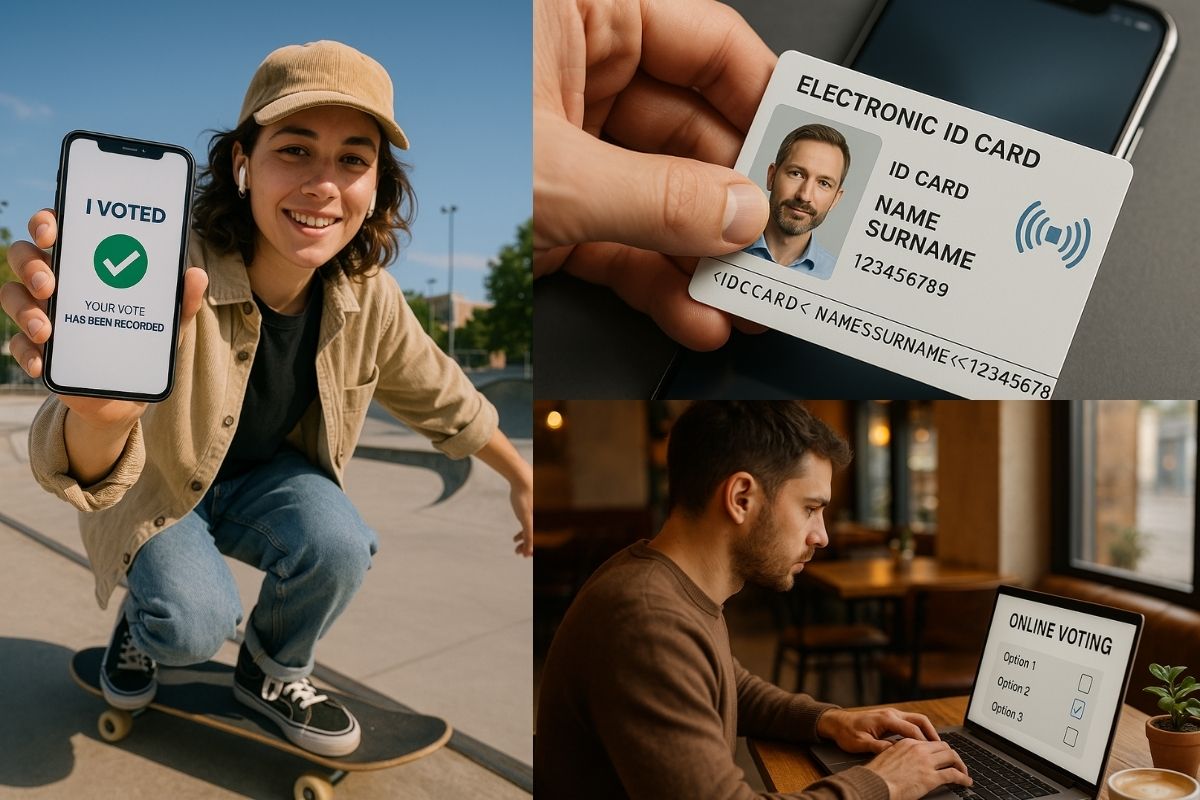
- Registration: Citizens use the eID function of the electronic national ID card (nPA) or passport (ePass) for one-time, physical identity verification. Smart-ID and Mobile-ID according to eIDAS-Level “high” store cryptographic keys on the device.
- Vote casting: Client-side homomorphic encryption (ElGamal/Paillier) and digital signature with the private key. Zero-knowledge proofs demonstrate correct vote transmission without revealing content.
- Blockchain storage: Proof-of-Authority network of state validator nodes writes encrypted votes into immutable blocks. A publicly visible explorer allows anonymous voting receipts, each voter can verify via receipt that their vote is stored unchanged.
- Counting: Threshold or threshold cryptography ensures joint decryption by multiple election officials. AI-based anomaly detection recognizes manipulation attempts in real-time. External audits and risk-limiting sample recounts ensure integrity.
Critical Questions:
- How do we prevent client malware that changes votes? Receipt-free systems and parallel paper voting as backup.
- Can insiders (administrative officials) manipulate? Threshold and multi-signature procedures minimize insider risk.
- Is quantum resistance guaranteed? Hybrid crypto procedures in preparation.
Why Swiss Model in Germany and Europe?
Germany does not yet know comprehensive popular decisions at all levels. The Swiss model could be transferred:
- Municipalities introduce citizen petitions (3% signatures) and citizen decisions (simple majority).
- Districts receive district citizen decisions (2% signatures) for regional tasks like public transport or hospital financing.
- States anchor state popular initiatives (5% signatures) and popular decisions with minimum participation (25%) in their constitutions.
- Federation introduces federal popular initiatives (100,000 signatures) and federal referendums (simple popular majority plus state majority) for constitutional changes and EU treaties.
Technically, this runs on a public-permissioned blockchain with nodes at each level. eID integration uses the nPA/ePass, smart contracts regulate deadlines and quorums, end-to-end encryption and zero-knowledge proofs ensure confidentiality and verifiability.

Gradual Rollout for Citizens and Administration
A safe and accustomed transition succeeds in four phases over five years:
| Phase | Period | Focus |
|---|---|---|
| Nationwide major votes | Months 0-12 | Determination of percentage shares Federation/State/Municipalities |
| State funds and special budgets | Months 12-24 | Division of state funds into education, environment, health |
| District and regional budgets | Months 24-36 | Quarterly decisions on public transport, hospitals, schools |
| Municipal participatory budgets | Months 36-60 | Drag-and-drop budgeting for schools, culture, social affairs |
Accompanied by information campaigns, workshops, AI assistance, accessibility, and external audits. Each phase builds on learning objectives, with fallback options and feedback loops.
How Do Taxes Flow and Who Decides About Them?
Swiss distribution: Federation 46%, Cantons 33%, Municipalities 21% of tax revenue. In Germany we propose:
| Level | Tax Share | Main Taxes | Decision Examples |
|---|---|---|---|
| Federation | 20% | Consumption tax, Corporate tax | EU policy, pensions, defense, highways |
| State | 30% | Income tax, Inheritance tax | Universities, police, state roads, environment |
| District | 20% | Regional additional levies | Public transport, hospitals, vocational schools |
| Municipality | 30% | Business and property tax | Schools, daycare, streets, culture, social assistance |
We would reduce the approximately 7,642 tax types to ten core taxes and assign clear responsibilities. Joint taxes (income, VAT, corporate) are distributed according to fixed percentages, separate taxes (tobacco, fuel) remain with the Federation, state taxes (inheritance, gambling) with the state, real taxes (business, property) with municipalities.
Economic Dimension and Labor Market
Digitizing votes requires investments of around 650 million € over three years, 70 million € annual operating costs, financed from EU funding pools, digitization funds, public-private partnerships. New jobs are created in blockchain engineering (5,000-7,000), AI security (2,000-3,000), and digital training (1,000). Medium-term, e-voting reduces the costs of traditional voting by an estimated 30%.
Citizens Can Demand Change
- Municipal initiatives: Start citizen petitions for e-budgets (3% signatures).
- State popular initiatives: Collect 5% of state voters for constitutional clause “E-Democracy”.
- Federal petition: 100,000 signatures for a debate in the Bundestag.
- Public relations work: Explanatory videos, workshops, alliances with More Democracy e.V. and civic-tech communities.
- Administrative cooperation: Propose pilot projects, participate as citizen representatives in digitization councils, establish monitoring teams.
AI Makes the System Better
AI personalizes dashboards, simulates scenarios, detects anomalies, scales infrastructure, moderates chats, translates automatically, and with gamification achieves more participation. Federated learning preserves data privacy, quantum resistance protects future elections.
Conclusion: Rethinking Direct Democracy
True participation begins with effective action: sign petition, start initiative, and become a GARN member. If you really want to be sure that something gets done, then do it yourself! Together we create a democratic system that is transparent, secure, and citizen-friendly – for a livable “children’s room Earth”.


