
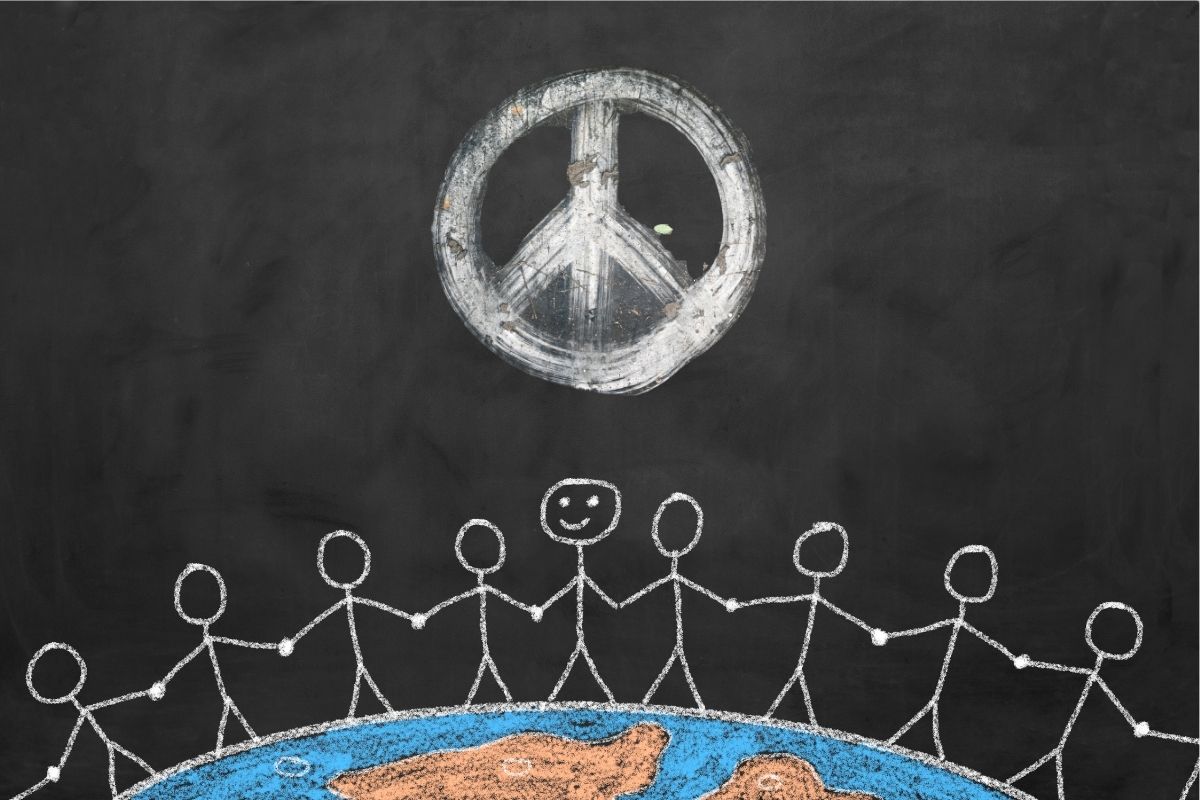
Peace Across Millennia: Lessons from the Jomon to Today
“The world would be much better if we listened more to our common sense, made time for each other, and treated everything with respect – nature, animals, and ourselves.”
Francesco del Orbe
Why We Seek Peace More Than Ever Today
In a world dominated by news of conflicts, crises, and social division, the thought of long-term peace may seem utopian. Yet human history and modern examples show that peaceful coexistence is possible – albeit under specific conditions. This article guides you through:
- A 12,200-year peace experiment
- The success recipe of the Jomon society
- The fate of other peace models
- Modern islands of peace
- A four-phase concept to transform our society nonviolently
- Dealing with different forms of violent individuals
- The foundations of a permanently peaceful world
12,200 Years of Jomon: The Longest Peace Experiment in Human History
Around 13,000 years ago, the Jomon culture began in Japan. Unlike wandering hunter-gatherer groups, the Jomon lived in villages of up to 500 people and maintained extensive trade networks: obsidian stone from Hokkaido traveled over 700 kilometers to Kyushu, jade from mountain regions reached the coast. Despite this complexity and contact possibilities, the violence rate in all studied skeletal findings was only 1.8 percent – a fraction of what other contemporary societies showed.

Why the Jomon Were Not Isolated Yet Remained Peaceful
Population Structure and Trade
With 260,000 people on the islands, density was only 0.75 people/km². Yet far from solitude, they developed specialized craftspeople, organized seasonal community meetings, and erected ritual sites with 50-meter stone circles. The island setting protected against mass invasions but did not force them into isolation.
Conflict Resolution Without Rulership
There were no feudal rulers: egalitarian assemblies made decisions. In disputes, they didn’t resort to weapons but to rituals and reconciliation ceremonies to restore honor and community bonds.
The Six Pillars of Jomon Success
- Optimal Population Density
Below 1 person/km² lacks specialization, above 3/km² creates resource conflicts. The Jomon were in the “Goldilocks” range. - Diverse Resource Management
They used seafood, forest nuts, wild animals, and fish in different seasons. No monoculture, but seasonal mobility. - Horizontal Complexity
Specialized craftspeople without a ruling elite, ritual centers without priest castes – thus power remained distributed. - Adaptive Institutions
Over millennia, they alternated between mobility and sedentarism, adapting settlement patterns to climate fluctuations. - Natural Shielding
The island group offered protection from large-scale conquest campaigns that destabilized other societies. - Nonviolent Conflict Mechanisms
Reconciliation rituals and collective sanctions prevented conflicts from escalating.
Endangered Peace Models: Why Others Failed
Moriori on the Chatham Islands
Four centuries of pure pacifism ended in 1835 when Maori warriors invaded and killed or enslaved 90 percent of the Moriori. Nunuku’s Law forbade any form of resistance – a fatal pacifism without defensive capability.
Easter Island (Rapa Nui)
Monumental stone figures and peaceful community life until reaching ecological limits: deforestation led to resource wars with violence rates of 15–20 percent.
Anasazi/Ancestral Puebloan
700 years of stable settlement construction (Mesa Verde, Chaco Canyon) gave way to drought and overcrowding, famine and conflicts, with violence rates climbing to 8–12 percent.
Peace Islands of the Present
Costa Rica
Abolished its army in 1979, invested in education and health. For 76 years, one of Latin America’s most stable democracies.
Iceland
Without an army and with 400,000 inhabitants, unchallenged at the top of the Global Peace Index since 2008.
Bhutan
Not GDP but Gross National Happiness is the state goal. Four pillars – sustainable development, environmental protection, cultural preservation, good governance – show alternative paths.
Four Phases to Global Peace
Phase 1: Subsidy Abolition (1–2 years)
– Make fossil fuel, agricultural, and corporate money subsidy-free
– Savings potential: $870 billion annually
Phase 2: Peace Dividend (3–5 years)
– 20% reduction in military spending
– Release of $3.6 trillion for social and civilian investments
Phase 3: Deregulation (5–10 years)
– Bureaucracy reduction and dismantling market barriers
– Economic freedom demonstrably leads to fewer conflicts
Phase 4: Voluntary Society (10–20 years)
– Gradual transition to minimal state or anarcho-capitalist models (Nozick, Rothbard)
– Voluntary cooperation instead of coercion, polycentric jurisdiction, private security services

Who Commits Violence – And How We Deal With It
91% of all violent acts can be solved without brutal coercive measures:
- Frustrated/Reactive Violence (70%)
– Cause: Poverty, trauma, stress
– Restorative Justice (70–85% success rate), dialogue instead of prison - Mental Health Crises (10–15%)
– Therapy and ongoing support (75–90% success rate) - Substance-Related Violence (15–25%)
– Medical treatment and rehabilitation (60–80% success rate) - Ideological Extremists (2–5%)
– Deradicalization and community integration (50–70% success rate) - Psychopathic Perpetrators (1–4%)
– Biologically/genetically conditioned, low empathy
– Humane detention as last resort (0% rehabilitation, 100% protection)
Only about 0.44% of the population requires lifelong humane detention, as shown by the Norwegian model with a 20% recidivism rate compared to 68% in the USA.
Seven Foundational Pillars for Lasting Peace
- Controlled Monopoly on Force
– Independent courts and legal recourse for citizens - Decentralization
– Local decisions with national coordination only when needed - Participation
– Citizens’ assemblies, referendums, digital platforms for real co-determination - Nonviolent Conflict Resolution
– Mediation and community circles - Transparency
– Open budgets, rotating offices, citizen juries - Culture of Cooperation
– School curricula for conflict and media literacy, community projects - Sustainable Foundations
– Ecology, social safety nets, fair markets without subsidies
Conclusion: Peace Requires Conscious Action
The Jomon have proven that humans can live 12,200 years away from war. Modern examples in Costa Rica, Iceland, and Bhutan confirm we have the means today to sustainably shape peace. But peace doesn’t arise spontaneously. It demands:
- Radical reforms in economy and governance
- Violence prevention through social and psychological support
- Participation and transparency
- Cultural values of cooperation
“If you truly want something done, just do it yourself!”
Let us act as guardians of Earth: build the structures for lasting peace and jointly take responsibility for our “nursery Earth.”


