
– Where Does the CO₂ from Photosynthesis End Up?
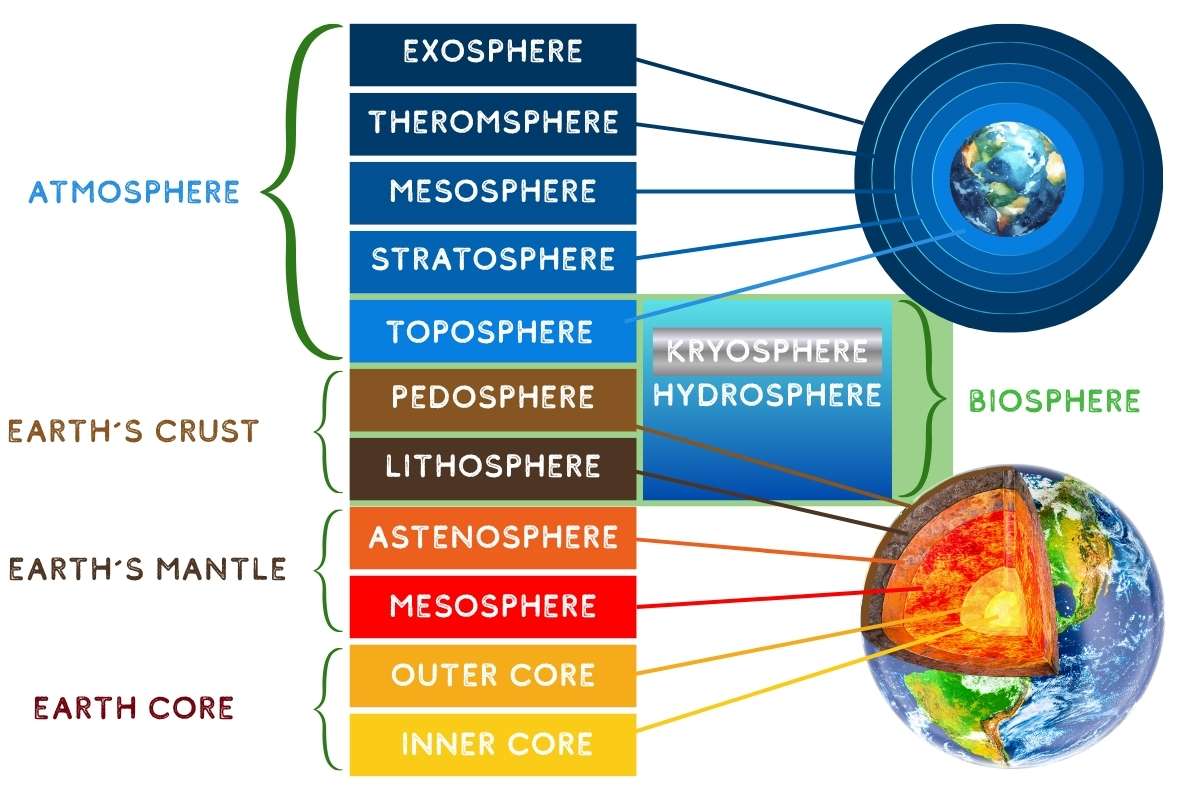
From outer space to Earth’s core, the planet is divided into distinct spheres, each characterized by unique material or physical properties: soil, rock, water, air, ice, etc., all of which interact and influence one another.
The atmosphere is the layer of gases surrounding Earth. In daily language, it is simply called “air.”
The troposphere is the layer closest to Earth’s surface. Above it are the stratosphere, mesosphere, thermosphere, and exosphere – the latter forming the boundary with space.
The ground layers begin with the pedosphere, hydrosphere, and cryosphere – the uppermost parts of the Earth’s crust. These are followed by the lithosphere, asthenosphere, mesosphere, and finally, Earth’s outer and inner core.
Well-known spheres include the atmosphere, biosphere, and hydrosphere. Many spheres overlap, interconnect, or form subcategories.
The cryosphere contains all snow and ice-covered regions, including ice sheets, glaciers, sea ice, and snowy landscapes.
The hydrosphere includes all water-covered areas such as rivers, lakes, oceans, and also groundwater and pore water in rock layers.
The biosphere encompasses all areas of Earth inhabited by life – and it is where the CO₂ cycle primarily takes place.
The stratosphere, containing the ozone layer, must be examined separately with regard to its CO₂ content.
Where Does the CO₂ from Photosynthesis Go?
Atmosphere: The Central Exchange Hub
The atmosphere contains 875 gigatons of carbon in the form of CO₂ and acts as the central hub, exchanging carbon with all other spheres. It is directly connected to vegetation-based CO₂ uptake via photosynthesis.
Biosphere: More Than Just Above-Ground Vegetation
The biosphere includes 550 gigatons of carbon stored in aboveground vegetation in the toposphere. However, 46% of total terrestrial carbon fixation is allocated belowground—representing 24.7 gigatons annually.
Pedosphere: The Active Underground Carbon Sink
Often considered a part of the lithosphere or the crust, the pedosphere stores 1,600 gigatons of carbon in organic matter — making it Earth’s largest terrestrial carbon pool. It acts as an independent and dynamic sphere in direct exchange with the atmosphere.
Lithosphere: The Giant Long-Term Storage
The lithosphere stores over 66 million gigatons of carbon (mainly as carbonate rock) and around 4,000 gigatons as fossil fuels. This carbon remains locked for geological timescales and is only released by human activities or rare geological events.
Hydrosphere: The Oceanic Buffer
The oceans contain 38,000 gigatons of carbon, exchanging around 70 gigatons per year with the atmosphere, buffering CO₂ fluctuations.
The Critical Moment: Carbon Transfer from the Toposphere to the Pedosphere
Quantified Carbon Allocation
19% of photosynthetic production is transferred into the soil as rhizodeposition, equivalent to ~166 kg of carbon per hectare per season for wheat — highlighting the significance of root-mediated carbon input.
Rhizodeposition Defined:
Different forms of carbon enter the pedosphere via rhizodeposition, including:
- Root exudates: Actively secreted sugars, amino acids, organic acids
- Root turnover: Decomposed root hairs and cell structures
- Mucilage: Polymers produced by root tips
- Volatile organic compounds: Gaseous emissions from roots
Fate of Rhizodeposited Carbon:
Out of the 19% carbon from rhizodeposition:
- 15% is decomposed into CO₂ by soil microbes
- 4% remains in the soil as stable organic matter
- 2.5% becomes microbial biomass

Why the Pedosphere Is Not Part of the Lithosphere
Time Scales of Carbon Storage:
Lithosphere: Carbon resides for millions to hundreds of millions of years
Pedosphere: 15–255 years, depending on climate zone – global average: 23 years
Exchange Intensity:
Lithosphere: No relevant natural exchange at climate-relevant scales
Pedosphere: Highly active – annual release of 68 gigatons of CO₂ from soils, about 1.8× fossil fuel emissions
Complete Carbon Budget: Global Flow Between Spheres:
| Process | Annual Flow | Direction |
| Photosynthesis | 120 Gt | Toposphere → Pedosphere |
| Plant respiration | 120 Gt | Vegetation (Toposphere) → Atmosphere (Toposphere) |
| Rhizodeposition | 50 Gt | Vegetation (Toposphere) → Pedosphere |
| Ocean exchange | 70 Gt | Hydrosphere ↔ Atmosphere (Toposphere) |
| Fossil fuel combustion | 37 Gt | Lithosphere → Atmosphere/Stratosphere |
Key Transfer: Toposphere Vegetation → Pedosphere
Plants allocate ~50 gigatons of carbon annually into the pedosphere, via:
- Structural root biomass – 27% of photosynthesis
- Rhizodeposition – 19%
- Mycorrhizal fungi – transporting carbon and nutrients from root to soil
Human Impact on This System
Loss from the Pedosphere:
Since the dawn of agriculture, soils have lost an estimated 133 gigatons of carbon, roughly 8% of global soil carbon reserves.
Tillage increases soil CO₂ by 45–51% compared to no-till systems.
Lithosphere Emissions:
Fossil fuel combustion releases 37.4 gigatons of CO₂ annually, roughly 0.55× the amount from natural soil respiration.
Conclusion: The Pedosphere as a Distinct Climate-Relevant Sphere
The pedosphere is not a subset of the lithosphere — it is a dynamic, distinct Earth sphere with climate-relevant functions:
- Largest terrestrial carbon sink directly active in climate processes
- Biological exchange with the atmosphere via photosynthesis and respiration
- Rhizodeposition connectivity to the biosphere
- Responsive to climate and land-use changes
19% of photosynthetic carbon enters the pedosphere, where it’s actively processed — this fact is crucial for understanding the global carbon cycle.
Failing to distinguish the pedosphere from the lithosphere obscures key mechanisms vital to climate strategy.
Only by recognizing the pedosphere as an active carbon sphere can we fully unlock its potential in climate mitigation.
Author: Francesco del Orbe 🌍


