
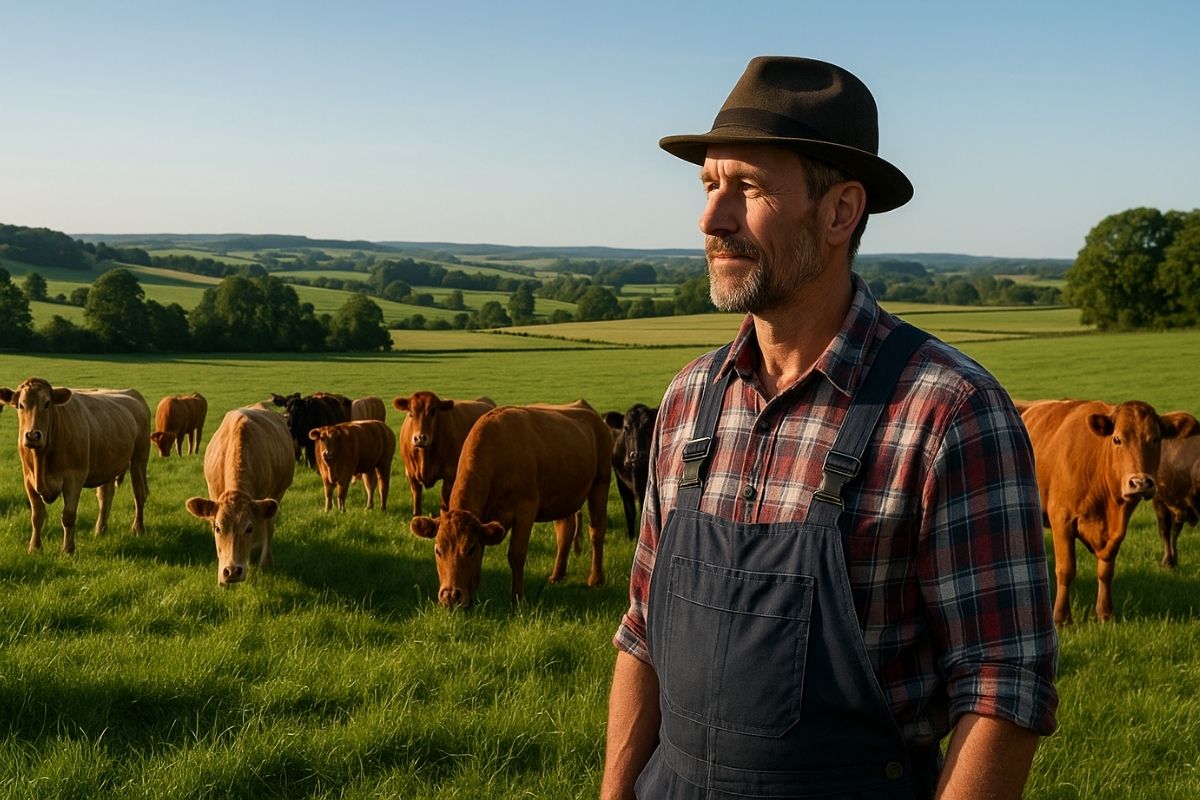
Dear readers, let us today dispel a widespread myth and lay the facts on the table: German farmers are far from being the problem of our environmental crisis – they are already the solution. But an inflated subsidy system keeps them trapped in a dependency trap, while innovative alternatives already prove that profitable agriculture without state crutches is not only possible, but even more lucrative.
Why is this topic so urgently current? Because we Earth Guardians experience daily how committed farmers are ground down between environmental protection ambitions and bureaucratic hurdles. While politicians talk about climate protection, they suffocate the true climate saviors – our farmers – in a sea of forms. Yet functioning models have long existed that show: Another agriculture is possible, profitable and environmentally friendly at the same time.
“We’ve been green for a long time – but the system makes us sick”
German and European farmers proudly show their ecological achievements in numerous documentaries. They have already understood what many politicians still need to learn: humus building through regenerative cultivation methods, biodiversity through flower strips, closed nutrient cycles and soil-conserving management are not only environmentally friendly, but also economically sensible.
These farmers have long become environmental protectors. They know that healthy soils bring higher yields, that biodiversity means natural plant protection and that sustainable methods are more profitable in the long term. Many already rely on extensive pasture farming, where cattle naturally graze large areas and thereby renaturalize entire landscapes – exactly the rewilding concept that we Earth Guardians propagate for healing our planet.
But the system blocks them with a flood of regulations, controls and bureaucratic hurdles. The irony is barely perceptible: while these farmers spend 25 percent of their working time on forms, certificates and authority appointments, they simultaneously fight for their economic existence. The EU’s GAP system – the Common Agricultural Policy – was originally developed after World War II for food security. Today it has become a 60 billion euro monster that devours 40 percent of the entire EU budget.
The Subsidy Paradox: How state aid becomes a trap
Here we must be honest: subsidies have lured farmers into a dependency trap. What was meant as help became shackles. State enterprises were responsible for 52 percent of global CO₂ emissions in 2023, while the five largest private companies caused only 4.9 percent. These figures clearly show: the individual farmer is not the cause of the climate crisis.
Nevertheless, he is made to believe that he must save the world through renunciation and ever stricter regulations – while the system itself is the real problem. Subsidies indirectly force farmers to subsidize chemical companies and rob people in low-wage countries of their livelihoods through unfair competition. That is the opposite of what we want as responsible Earth Guardians.
The dependency trap works like this: farmers are seduced by subsidies to orient their production toward state specifications instead of market needs. They must fulfill complex regulations that often have little to do with genuine environmental friendliness, but cause a lot of paperwork. At the same time, they become alienated from consumers, since they no longer produce directly for their customers, but for anonymous markets and bureaucratic specifications.
The New Zealand Miracle: Why less state means more success
In 1984 something revolutionary happened: New Zealand abolished all agricultural subsidies overnight – in the middle of a state crisis. Many experts prophesied the end of New Zealand agriculture. The opposite occurred.
In the short term it was painful: many inefficient farms went bankrupt, land prices collapsed. But the remaining farms thereby became more efficient and market-oriented. Today New Zealand is a model country: 73 percent of New Zealand’s export revenues come from subsidy-free agriculture. A Swiss emigrant reports: “We earn more today, it costs the state nothing more. And taxes are falling.”
The New Zealand model proves: agriculture without subsidies is not only possible, but leads in the long term to more efficient, more market-oriented, healthier, more ecological and ultimately more profitable agriculture. The farmers suddenly produced what consumers really wanted, instead of what the state subsidized.
“Feeding 125 families with two hectares” – The CSA Revolution
Here comes a surprising insight: subsidy-free, profitable agriculture needs significantly less land than conventional production. While the average German farm manages 63 to 66 hectares and still depends on subsidies, alternative models can function profitably from just two to five hectares.
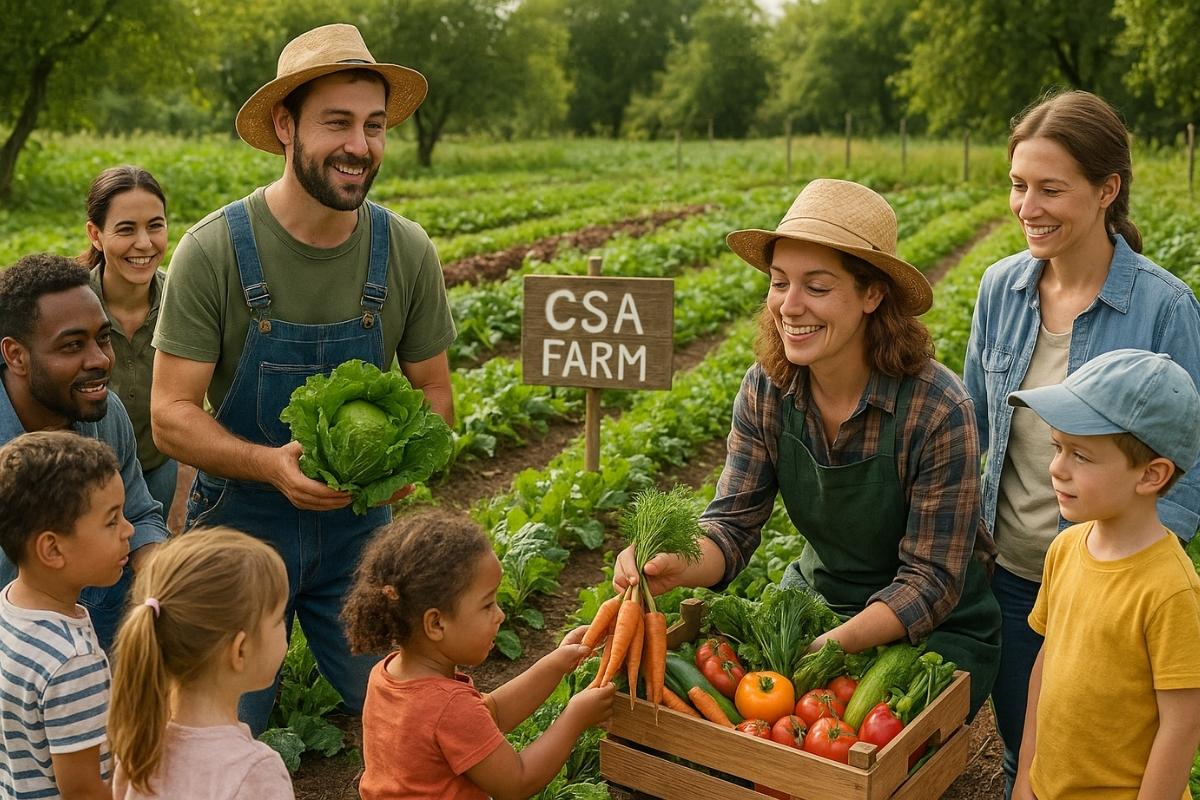
The CSA model – Community Supported Agriculture or in German “Solidarische Landwirtschaft” – functions according to a simple but revolutionary principle: a consumer community takes over the complete annual costs of a farm and receives proportionally the harvest in return – without market price fluctuations, without risk for the farmer.
The numbers speak a clear language: two hectares can supply 125 households with vegetables, with 100 percent cost coverage plus adequate wages for the farmer. Per household that’s only 200 to 400 square meters share – with 60 to 120 euros monthly contribution for healthy food from controlled cultivation, instead of chemically contaminated, sickening waste from industrial mass production.
With over 400 farms throughout Germany and 40,000 participating households, CSA proves: it works. The farmers have plannable income, consumers receive fresh, high-quality food, and both sides build a personal relationship. That is the opposite of anonymous, subsidy-driven mass production.
Direct Marketing: When the farmer becomes an entrepreneur again
In Austria, 30,000 farms – that’s 28 percent of all farms – achieve on average 33 percent of their income from direct marketing. From 2010 to 2016, this share could be doubled from 17 to 34 percent. The reason is simple: direct marketing brings 11 to 15 euros per kilogram instead of six euros in wholesale.
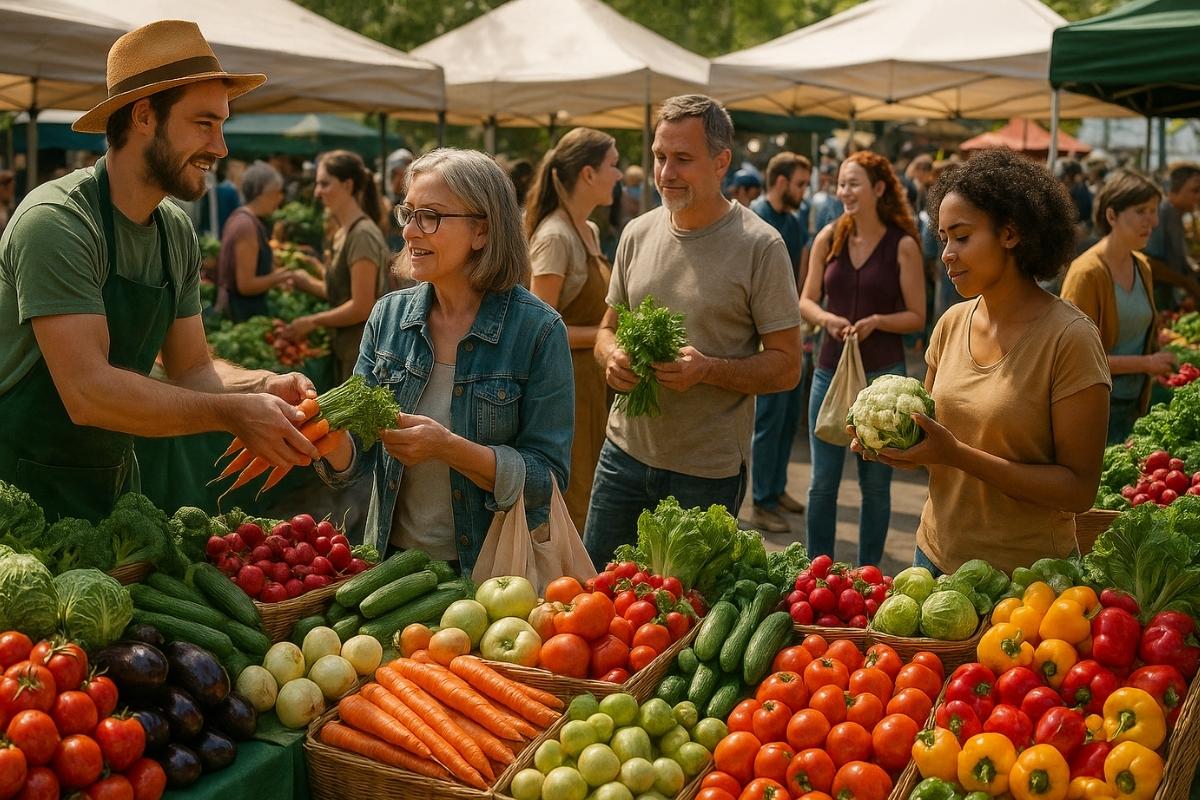
Direct marketing means: the farmer sells his products directly to the end consumer – through farm shops, weekly markets, online platforms or innovative self-service machines for 24-hour sales. This eliminates the margins of intermediaries, supermarkets and processors. The farmer gets the full value of his work, the consumer receives fresh, regional products.
Particularly successful are thematic farm shops that concentrate on regional specialties, combined with experience offerings like farm festivals, cooking courses or children’s birthdays. Modern farmers also use delivery services with subscription models – customers regularly order fresh products that are delivered directly to the front door.
Permaculture: When nature gives the maximum
The most revolutionary insight comes from permaculture research: 40 tons yield per hectare are possible – compared to seven tons of wheat in conventional agriculture. Swiss studies by ZHAW prove that permaculture farms already achieve a work income in the first year that is comparable with conventional agriculture.
Permaculture – that stands for “permanent agriculture” – uses the principles of natural ecosystems. Instead of working against nature, it works with it. The secret of success lies in staggered use through a floor system: trees, shrubs and herbs grow on top of each other and use space optimally.
These systems achieve triple density compared to conventional systems, require less care through self-regulation and rely on perennial plants with high yields with little work. For self-sufficiency, 15 to 20 square meters per person are sufficient for basic supply – a four-person family thus needs only 60 to 80 square meters with intensive permaculture.
“What if all farmers in the village want to participate?” – The demand problem
This question brings us to an important point: what happens when all farmers in a village want to switch to alternative models? A village cannot have 30 CSA farms next to each other – the local consumers are not sufficient.
The calculations are sobering: a CSA farm with two to five hectares supplies 35 to 125 households. A village with 1000 inhabitants has approximately 400 households – that means maximum three to four CSA farms per village are possible. With direct marketing the problem is similar: local markets are quickly saturated.
Here shows the weakness of individual solutions: they work excellently for individual pioneers, but they don’t scale for an entire region. When 30 to 40 farmers of a village want to switch simultaneously, they need another model. And exactly here comes the revolutionary rewilding cooperative model into play.
The Rewilding Miracle: 800 cattle renaturalize 2000 hectares
The rewilding cooperative model elegantly solves the scaling problem: 30 to 40 farms bring their land into a cooperative and let large cattle herds live freely on their fields or additionally leased, degraded areas. These cattle renaturalize entire landscapes through their natural grazing – and generate multiple income sources.
The concept is captivatingly simple but highly effective: with 0.2 livestock units per hectare the rehabilitation phase begins. 400 cattle break through crusted soils on 2000 hectares, distribute natural fertilization through their manure and transport seeds in their fur over long distances. After three to four years, the stock can be increased to 600 to 800 animals, since the vegetation meanwhile provides more biomass.
The success record is impressive: ELER funding brings 880,000 euros annually for extensive grazing, the sale of 120 to 160 young animals another 180,000 euros per year. Ecotourism and carbon credits for CO₂ storage supplement the income. The bottom line remains 940,000 euros net profit per year for 30 to 40 cooperative members – that’s 23,500 to 31,300 euros per former farmer, without the usual bureaucracy and subsidy dependency.

Successful Role Models: From Holland to Lusatia
The Oostvaardersplassen in the Netherlands shows since 1983 with 5,600 hectares that self-regulating herds work. The March-Auen in Austria have been a WWF showcase project since 2015 with 80 hectares. The planned Oder Delta with over 50,000 hectares will be Europe’s largest rewilding project.
In Germany, post-mining landscapes offer ideal conditions: the Lusatian district has over 10,000 hectares available contiguously, the Rhenish district plans with 15,000 hectares, the Leipzig region provides 8,000 hectares. Lease prices are minimal – 50 to 100 euros per hectare in post-mining landscapes, often even free in exchange for care obligations.
The scientific successes are measurable: 40 percent higher biodiversity after five years of extensive grazing, soil regeneration through manure and trampling compaction, massive carbon storage in renaturalized soils and improved flood protection through increased water retention.
The Hybrid Model: When customers become partners
The most ingenious further development combines rewilding with meat CSA and crowdfunding. 200 to 400 households buy their meat in advance – like in the successful “Cowfunding” or “Mein Schweinderl” models.
The advantages are overwhelming: 150,000 to 300,000 euros pre-financing per year through CSA members eliminate the biggest business risk. Crowdfunding massively reduces the start-up capital requirement. Premium meat prices of 15 euros per kilogram instead of six euros in wholesale double the margins. Total revenues rise to over 1.4 million euros annually.
Families pay 75 to 100 euros monthly for five to seven kilograms of high-quality meat plus farm visits and nature experience. Premium customers invest 60 to 105 euros monthly in dry-aged steaks and exclusive cooking courses with top chefs. This is the opposite of anonymous meat production: customers know where their meat comes from, how the animals have lived and actively support landscape care.
“Help, I can’t get out!” – The advisory network for desperate farmers
Farmers who simply can’t and don’t want to anymore, who have no more desire for EU reprisals and debt burden and want to take the step, are not alone. A comprehensive advisory network is available, and many offers are free.
Debt counseling is available throughout Germany – around 3,000 counseling centers help free with over-indebtedness, conduct creditor negotiations and accompany personal bankruptcy procedures. Agricultural chambers offer ten subsidized counseling hours for crisis intervention within the pilot project “Financial check out of the crisis”.
The CSA network with over 400 farms offers experience exchange, founding advice and mentoring by experienced farmers. The agricultural worry telephone at 0800-2178-000 is available around the clock, anonymous and specially trained for agricultural families.
The Social Insurance for Agriculture (SVLFG) has significantly expanded its offer: a crisis hotline staffed by psychologists seven days a week around the clock, plus cost coverage for ten hours of socioeconomic counseling and mediation in family conflicts.
Fair Participation: When good ideas are rewarded
Whoever develops thoughtful concepts that enable million-euro profits for farmers deserves fair participation. With 940,000 euros annual profit of a rewilding cooperative, three percent profit participation – that would be 28,200 euros – is more than appropriate. That’s only 806 euros per saved farmer.
In industry comparison that’s even modest: management consulting usually takes ten to 20 percent of achieved savings as success fee. With 880,000 euros saved subsidies that would be 88,000 to 176,000 euros per year. Software licenses cost five to 15 percent of turnover, patents two to eight percent, franchising three to seven percent.
Various models are conceivable: the hybrid model with 500 to 1000 euros basic fee per cooperative member plus two to three percent profit participation from the third year creates long-term partnerships. The honorary cooperative based on the senior cooperative model offers co-determination rights, lecture rights and network access instead of monetary remuneration.
Climate Donations and Earthprint: How farmers become world saviors
There is no technical solution that can bind CO₂ as quickly and efficiently as nature – we just have to help it. The rewilding cooperative concept for complete conversion of industrial livestock farming to extensive, healthy and species-appropriate pasture farming is the key to this.
Become an Earth Guardian and help us cool the planet by creating your positive Earthprint and living eco-positively. The term Earthprint denotes the positive, regenerative influence of a person or organization on the entire earth system – far beyond CO₂ compensation. It’s about active healing and restoration of ecosystems, climate, biodiversity and social communities.
As Mahatma Gandhi said: “Be yourself the change you wish for this world.” Because when something must be done and you want to be sure it gets done – do it yourself! That is our main slogan and our philosophy.
Worldwide, less than one percent of all donations are spent on climate protection that simultaneously protects habitats, creates livelihoods and can prevent migration. Every Earth Guardian can create new worlds from just 0.09 cents a day, if we take the global gross domestic product as a basis and act together.
We Earth Guardians are members of the Global Alliance for the Rights of Nature (GARN). Help us sign the petition and together take responsibility for our “nursery Earth”. Because if we were adults, we would never treat our home like this – I know no adults who drive a bulldozer through their living room or bedroom.
Conclusion: The agriculture of the future awaits us
The agriculture of the future is already here – it just waits to finally be lived. German farmers can again be proud of their work, without being patronized by bureaucracy and subsidies. The presented models prove: profitable, environmentally friendly and socially responsible agriculture is possible.
The New Zealand model has shown that farewell to subsidies is painful in the short term, but liberating in the long term. CSA and direct marketing already work for thousands of farms. The rewilding cooperative model solves the scaling problem for entire regions. Hybrid models with end consumer participation maximize profit and environmental benefit.
The key lies in three principles: build direct relationships with consumers, develop multiple income sources and use regional networks. Subsidies have made farmers dependent – but the solutions for more independence already exist and work in practice.
Let us now save our homeland – our mother Earth, because “we all are the world!” The time of the Earth Guardians has come. Become part of the revolution that fights not against, but for life. Francesco del Orbe said it aptly: “The world would be many times better if we listened more to our healthy common sense, took time for each other and treated everything with respect – nature, animals and ourselves.”


