
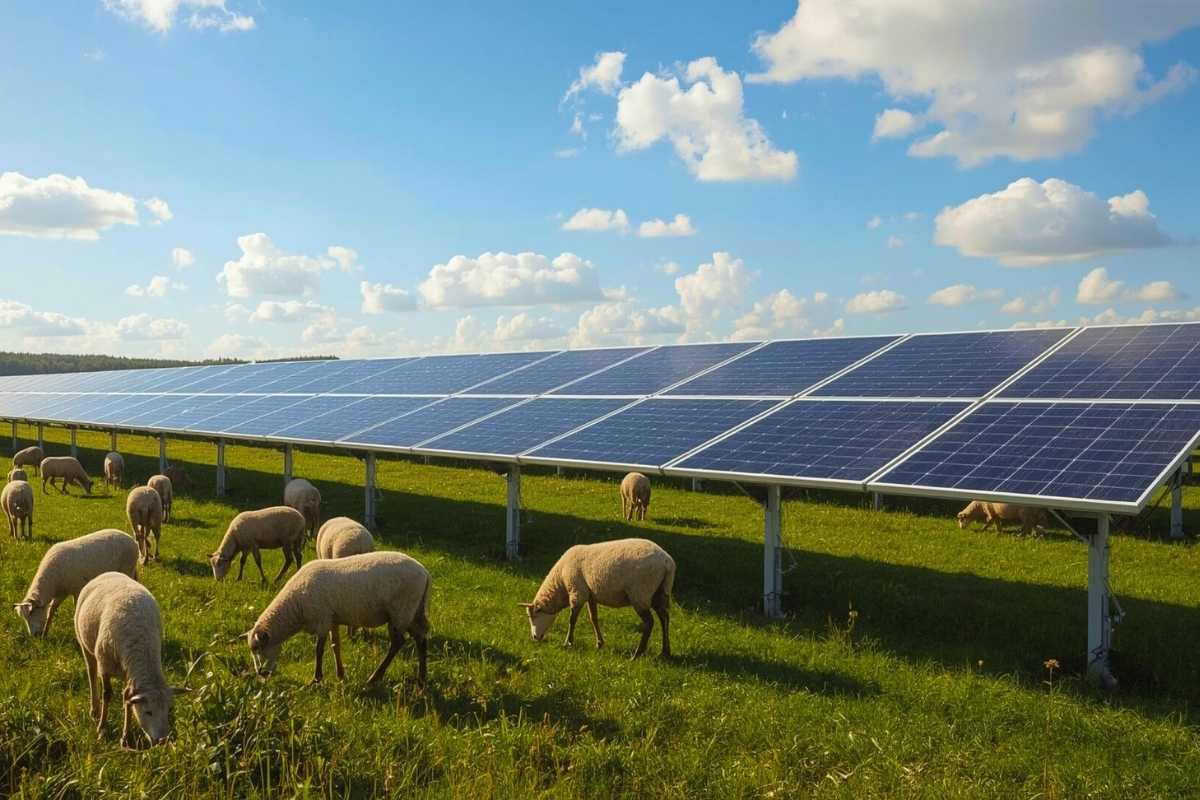
– Dual Use through Sustainable Sheep Grazing
The Future of Solar Energy: More Than Just Electricity
Solar parks are a central element of the energy transition. But their role goes far beyond mere electricity production. In times of scarce land and ambitious climate targets, solar parks must increasingly be used as multifunctional areas – with targeted greening, extensive grazing, and sustainable sheep farming.
Why CO₂ Savings Alone Are Not Everything
The often-cited “CO₂ savings per hectare/year” is not a cure-all. The values vary depending on the usage concept and are only partially comparable:
- Solar parks mainly avoid emissions by replacing fossil electricity production – the effect is immediate but indirect.
- Afforestation sequesters CO₂ directly in wood and soil, but over decades.
- Extensive grazing (e.g., with sheep) promotes humus formation and stores carbon in the soil – slowly but sustainably.
Only the combination of these uses unlocks the full potential.
Sheep Grazing under Solar Panels: A Win-Win for Climate, Agriculture, and Nature
Extensive sheep grazing on solar land is a prime example of efficient dual use:
- Electricity and agriculture on one area: The land produces renewable electricity and high-quality food simultaneously.
- More carbon in the soil: Grazing demonstrably increases soil carbon storage by up to 80% compared to unused land.
- Biodiversity and landscape management: Sheep keep vegetation low, promote species-rich meadows, and prevent shrub encroachment – a gain for biodiversity.
- Sustainable sheep farming: Sheep live long lives, are sheared annually, and provide valuable wool year after year.
- Sheep wool as sustainable long-term fertilizer: The harvested wool is processed into pellets, which are used as a natural, long-lasting fertilizer on the land. This creates a closed nutrient cycle and further strengthens the soil.
Comparison of Usage Concepts
| Usage Concept | CO₂ Savings/Sequestration per ha/year | Main Mechanism | Special Features |
| Solar park (electricity only) | 175–200 t CO₂ | Avoidance of fossil emissions | Very high savings, no direct sink |
| Afforestation | 0.8–15 t CO₂ | Slow sequestration in wood and soil | Biodiversity, long-term storage |
| Extensive grazing (sheep) | 1–3 t CO₂ | Humus formation, roots, plant remains | Biodiversity, regional added value |
| Agri-PV with extensive sheep grazing | 2–4 t CO₂ (direct sink) + electricity replacement | Combination of electricity offset and soil sequestration | Synergy effects, dual use, sustainable wool as fertilizer |
Values are approximate and vary by location, management, and electricity mix. Effects should be transparently reported for an honest climate balance.
Conclusion: Solar Parks as Multifunctional Climate Protectors
Solar parks must no longer be seen merely as electricity suppliers. Mandatory greening, the integration of extensive grazing, and sustainable use of sheep wool as a long-term fertilizer must become the standard to unlock their full potential for climate, nature, and agriculture.
Recommendation:
Every new solar park should be planned and operated as a CO₂ sink, agricultural land, and sustainable circular system. This will turn solar parks into real climate protectors that unite energy, nature, and regional value creation.
Author: Francesco del Orbe 🌍


